Woman with clipboard standing in front of distant heavy haulage vehicle working out why heavy haulage planning matters.

Why Heavy Haulage Planning WA Matters 

Heavy haulage planning WA requires strict regulatory compliance, stringent safety measures, and comprehensive risk assessment.

When you imagine hauling a 40-metre wind turbine across WA, you likely wonder what kind of equipment could even accomplish that. But heavy haulage project planning is far more complex than just lining up specialty equipment.

Heavy haulage also involves limited infrastructure in remote areas, weather-related road closures, weight restrictions, tight turns, and complicated permits.

After transporting thousands of tonnes of equipment safely and on time, we know the strategies needed to tackle these challenges.

Here, we’ll share the step-by-step guide to navigating the complexities of oversized transport planning.


Step 1 – Define the Load and Transport Requirements

Understanding Load Dimensions and Weight

The first step in oversized transport planning is a comprehensive freight assessment. Accurate measurements are critical for maximising efficiency, obtaining the proper permits, and ensuring safety.

A detailed cargo analysis should accurately identify the freights:

  • Length
  • Width
  • Height
  • Gross mass
  • Special handling requirements or concerns
  • Specific restraint needs


Determining the Right Transport Method

Standard heavy haulage vs over dimensional transport is determined by Australia’s specifications.

These vary based on territory and state, but they generally refer to:

  • Oversized: Items exceeding 30 tonnes
  • Overdimensional: Cargo exceeding 2.5 metres wide, 4.3 metres high, or 19 metres long

For oversized or overdimensional transport, specialised machinery, adherence to regulations, and proper permits are required.

Learn more about what determines if an item is oversized or overdimensional here: Heavy Equipment & Machinery for Haulage – Classification Guide. 


Step 2 – Assess Routes, Access, and Site Conditions

Route Surveys and Road Constraints

A route survey is a detailed inspection of the path of transport to identify obstacles or concerns, such as:

  • Overhead obstructions and clearance heights
  • Tight turns
  • Bridges
  • Road-widths
  • Gradant limitations
  • Weight-restricted roads
  • Construction zones

Once these potential obstacles are identified, advanced route mapping tools can determine the most efficient, safest route.

A detailed contingency plan is also developed to mitigate any unexpected road closures or traffic issues. This maximises safety and reduces the risk of delays.


Site Access at Pickup and Delivery

Site access at pickup and delivery requires meticulous planning to ensure safety and keep the transport process on schedule.

Securing site access and safe pickup and delivery requires:

  • Continuous, clear coordination with site managers and contractors
  • Cleared access routes
  • Comprehensive safety briefings for any personnel who will be present
  • Clearly marked exclusion zones
  • Risk assessments
  • Appropriately sized hardstands
  • Clear crane access
  • Designated laydown areas
  • Appropriate ground conditions that will support the weight of the equipment during the loading or unloading process

Learn our recommendations for prepping your site for heavy haulage freight here: How to Prepare Your Site for Heavy Haulage Delivery.


Step 3 – Permits, Approvals, and Compliance

Oversize and Overweight Permits

Oversized transport planning also requires proper permits from local councils and state road authorities, such as Main Roads WA.

Determining which permits are required and applying for them is a complex, time-consuming process. You’ll need detailed documentation showing proposed routes and exact load specifications.

Depending on the type of freight and the state or territory, WA approval timelines often take several weeks.

Repeat after us: Obtaining permits is not something to leave for the last minute.

Learn more about what permits are needed and the approval process here: Oversized Load Regulation and Permits: A Complete Guide.


Escort Vehicles and Traffic Management

Many oversized or overdimensional loads will require escort vehicles. Escort vehicles guide the main haulage vehicle, warn other drivers, help manage traffic, and enhance safety.

Regulations surrounding escort vehicles in WA are complex and vary based on region, load type, and freight size. We also recommend researching regulations on night movements, curfews, and temporary traffic management along your planned route.

Learn more about escort vehicle requirements in heavy equipment transport WA here: Heavy Haulage Escort Vehicles.


Step 4 – Selecting Equipment and Trailers

Matching Trailers to the Load

Matching the appropriate trailer to the load ensures proper weight distribution and load stability. This enhances efficiency and safety, ensuring a smooth, timely transport.

Some common types of trailers and heavy haulage equipment include:

  • Pallet freight trailers for transporting goods, even during harsh conditions or challenging weather
  • Single semi-trailers carrying heavier loads such as livestock, bulk materials, hazardous chemicals, industrial items, and consumer goods
  • Drop deck trailers for taller cargo
  • Extendable trailers for large farm equipment or agricultural goods
  • 50 Tonne or 75-tonne Quad Spread Deck and Dolly for transporting oversized cargo, such as construction materials or machinery
  • B-Doubles (prime mover towing two semi-trailers) for transporting dangerous goods, liquids, or hazardous materials

Learn more about common trailers in the heavy haulage industry here: Types of Trailers in Trucking and Freight Industry.


Securing and Load Restraint Planning

Oversized freight must be secured in compliance with Australian load restraint standards. These standards are governed by Australia’s relevant state laws and the

National Heavy Vehicle Regulator (NHVR) and the Load Restraint Guide.

Learn More: Tips to Safely Load and Unload Heavy Haulage Equipment


Step 5 – Scheduling, Timing, and Risk Management

Timing Movements Around Site and Road Conditions

One of the biggest strengths of successful heavy haulage planning is adaptability. Establishing contingencies and pre-planning alternate routes is imperative to avoiding delays in the event of accidents or weather-related issues.

Weather impacts play a significant role in heavy haulage planning WA. From cyclones and bushfires to flash floods, Australia faces frequent weather-related logistics challenges.


Fatigue Management and Driver Compliance

Managing long-distance WA routes involves complex safety and legal obligations. One of the most important aspects of driver safety is fatigue management.

Driver fatigue can cause impaired judgment and reduced reaction times that pose alarming safety risks. Because of this, fatigue management is one of our main focuses.

The safety of your freight, staff, our drivers, and road users is our top priority at Australia Wide Haulage. We adhere to strict fatigue management practices as part of our non-negotiable commitment to safety.

Learn more about the importance of fatigue management in our post here: Truck Driver Fatigue Management Guide – Key Strategies.


Step 6 – Coordinating Delivery and On-Site Execution

Communication Across All Stakeholders

Clear, transparent communication across all stakeholders is key to coordinating safe transport and delivery. Stakeholder communication keeps drivers, regulators, customers, and all involved parties in the loop regarding timelines, delays, and progress.

Heavy haulage in Western Australia will likely require communicating with:

  • The transport team
  • Crane crews
  • Site supervisors
  • Local councils
  • Escort vehicles
  • Customers
  • Logistics teams


Managing Remote and Regional Deliveries

Planning for remote and regional deliveries requires extra knowledge and time due to limited infrastructure.

For instance, mine sites can be hundreds of miles from nearby cities and located in areas with zero cell service.

Learn more about how we manage challenging remote conditions here: Remote Delivery Services Perth – Reliable Remote Freight Delivery.


Why Working With an Experienced Heavy Haulage Partner Matters

Benefits of Hiring a Heavy Haulage Company include:

  • Reduce safety risks, cost, and downtime
  • Prevents common mistakes
  • End-to-end capability from planning through delivery
  • Avoid fines
  • Protect equipment and freight and avoid costly repairs
  • Maximum safety for your equipment, staff, and other road users
  • Eliminate the need to invest in specialty heavy haulage equipment

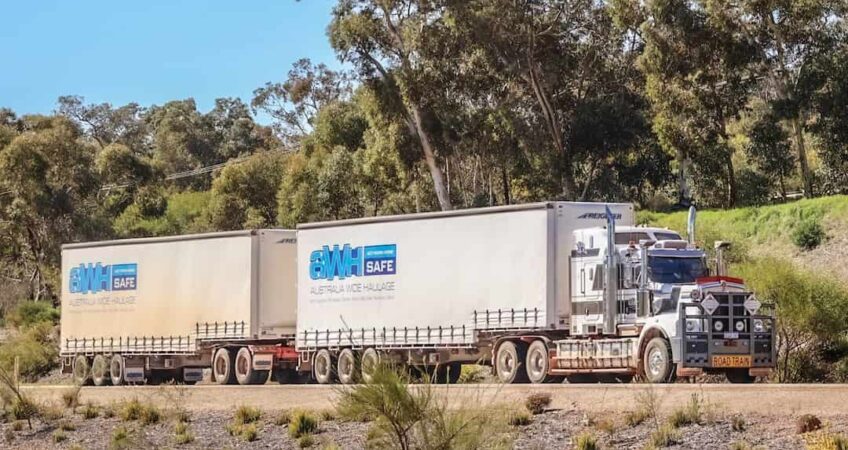
At Australia Wide Haulage, our extensive fleet and highly trained drivers can handle any oversized transport. From drop decks to B-Doubles to oversize road trains, our modern line haul fleet can meet your heavy haulage needs.

We offer end-to-end heavy haulage Western Australia project management that includes:

  • Obtaining all appropriate permits
  • Scheduling of pilot or escort vehicles
  • Communication across all channels, including coordination with local authorities, utility companies, and subcontractors
  • Comprehensive risk management, including proper insurance coverage and strict safety management systems
  • Correct load distribution
  • Experienced, motivated drivers who are classified as the best in their field

Learn more about our heavy equipment transport WA here:


Planning Heavy Haulage Western Australian Projects

Safe and successful heavy haulage transport WA demands intricate planning, detailed routes, appropriate communication, and proper permits.

Heavy haulage project planning is vital for safety, meeting project timelines, and protecting valuable equipment and freight.

With years of experience across mining, infrastructure, and remote projects, we understand how to manage the unique challenges of heavy haulage.

If you are planning a heavy haulage project in Western Australia, we are here to help. Contact our team to discuss your load, timelines, and logistics requirements.
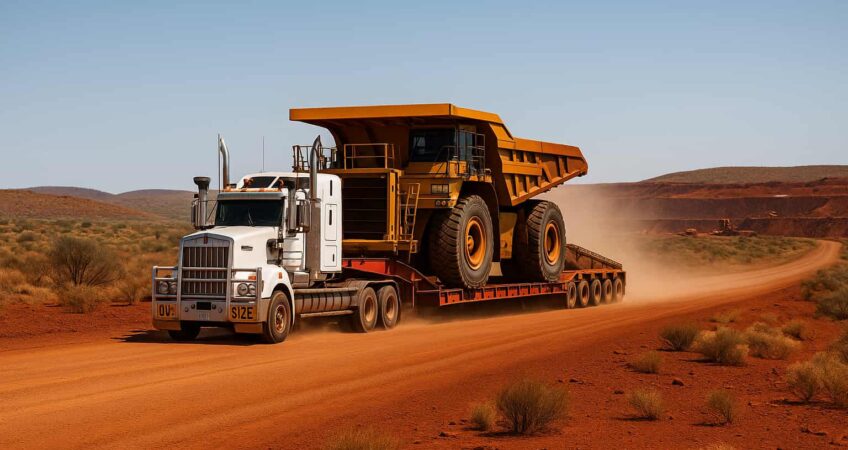
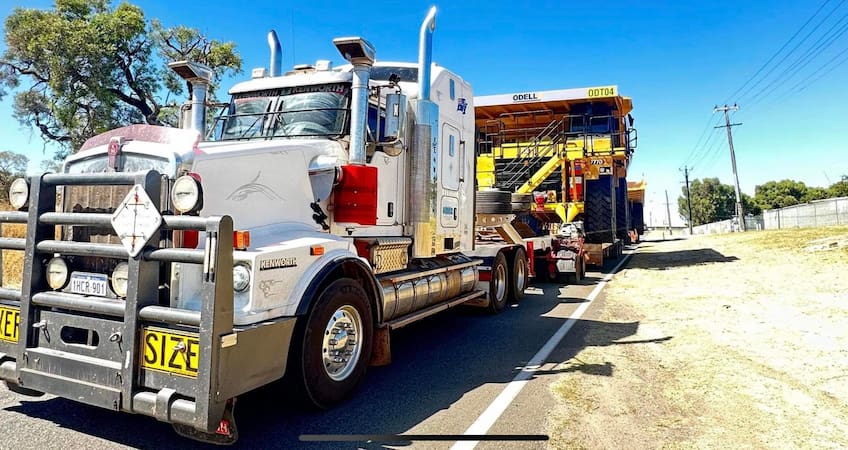
 

Heavy haulage road train transporting oversized mining equipment in a harsh mining environment in Western Australia

Maintaining Heavy Haulage Fleets in Harsh Mining Environments

Maintaining heavy haulage fleets in harsh mining environments requires proactive measures and specialised fleet care to ensure safe, reliable transport.

From dust and heat to corrosion, mining environments in WA place extreme strain on trucks, trailers, drivers, and maintenance teams.

Here’s how we keep our fleet reliable and safe despite harsh mining environments across WA.


Why Mining Conditions Demand Higher Maintenance Standards

Heat, Dust, and Load Stress

The intense heat and dusty conditions found in WA mines place significant stress on equipment.

The main environmental pressures our fleet faces include:

  • Extreme Climate: Soaring temperatures, drastic temperature swings, and harsh UV rays place immense stress on engines and lubricants. Learn more about the environmental impact on heavy haulage here: Weather-Related Logistics Challenges.
  • Dust Exposure: Dust and sand particles impact cooling systems, filters, and electrical components.
  • Heavy Loads: Heavy loads increase strain on drivelines, suspension systems, and tyres.
  • Isolation: These remote sites can be hundreds or even thousands of kilometres from the nearest city. This isolation often means poor or no reception and lack of support systems.

Our proactive approach allows us to be prepared for these environmental challenges and difficult conditions.

Learn more about the challenges of maintaining heavy haulage fleets in mining here: What is Haulage in Mining? | Mining Logistics Explained.


Core Fleet Maintenance Practices We Rely On

Preventive Servicing for Harsh Conditions

We’d much rather prevent problems in the first place than risk downtime or reduced safety.

Our servicing approach for remote heavy transport includes:

  • Shortened service intervals and custom maintenance schedules
  • Increased inspection frequency
  • Cooling and filtration checks
  • Strict servicing schedule of filters, batteries, fluids, seals, and belts (these minor components can lead to significant failures and costly downtime when ignored)
  • Oil sampling and condition monitoring
  • Protective anti-corrosion coating and rust inhibitors
  • Daily equipment inspections and pre and post trip inspections


Predictive Monitoring and Data-led Decision Making

Predictive analytics allow us to take a proactive rather than reactive approach to maintenance.

All of our heavy haulage vehicles are equipped with advanced sensors for real-time monitoring and predictive maintenance alerts. By detecting issues early, we can reduce downtime and optimise service schedules.

Digital reporting and telematics ensure detailed monitoring to provide early detection of issues, such as:

  • Temperature spikes
  • Brake wear
  • Fault codes
  • Vibration patterns
  • Improper tyre pressure


Managing Wear on Key Components

Engines, Transmissions and Drivelines

Constant vibrations, dust, thermal stress, and corrosion can quickly deteriorate seals, metal parts, and engine components.

Harsh mining environments cause these components to fail most frequently:

  • Engines
  • Transmissions
  • Drivelines
  • Hydraulic systems
  • Tyres

Our extensive maintenance regime ensures all components are working in top condition and free of defects. Detecting and addressing minor issues early on significantly reduces the risk of downtime.

Learn More: Planning and Preparing Oversized Transport


Braking Systems and Downhill Control

With mining trucks weighing thousands of tonnes and challenging terrain, controlling downhill momentum is vital.

We ensure safe downhill management for our fleet with:

  • Robust, premium brake systems
  • Extensive brake checks
  • Preventative maintenance
  • Retarder use
  • Ongoing driver education covering safe braking techniques, such as downshifting, progressive braking, snubbing, and anticipatory braking


Tyres, Suspension and Road-Shock Protection

Preserving tyres and suspension systems is one of the tougher aspects of maintaining heavy haulage fleets in harsh mining environments.

The extreme loads place significant stress on suspension systems and tyres. Corrugations, unsealed roads, sudden load transfer, and uneven surfaces make the risk of structural failure even higher.

Our approach to these challenging conditions includes:

  • Advanced real-time monitoring and sensors to detect irregular tyre pressure, damage, tread issues, or alignment concerns
  • Daily tyre inspections
  • Tread cleaning to prevent build-up and damage
  • Custom rotation and alignment schedule to prevent uneven pressure or excessive wear and tear

These measures go beyond standard heavy haulage maintenance, allowing us to prolong tyre life and suspension integrity.

Truck showing how are mining trucks transported

Reducing Dust and Heat Impact on Fleet Performance

Filtration, Cooling and Airflow

Proper filtration, cooling, and airflow are crucial for managing the dusty, hot environment of mining sites.

We support proper airflow, cooling, and filtration with these strategies:

  • Radiator cleaning
  • Charge-air cooler inspections
  • Frequent air filter maintenance
  • Managing dust ingress


Protecting Electrical and Hydraulic Systems

Sensors, wiring, hydraulics, and electronics are especially vulnerable to the excessive heat and dust found at mining sites. Moisture and acidity in the air can corrode these sensitive components.

Our extra steps to protect electrical and hydraulic systems to withstand harsh mining environments include:

  • Regular fluid changes, with a focus on detecting particle contamination
  • Use of premium fluids that are specifically manufactured to hold up better in Australia’s harsh climate
  • Driver education on how to inspect cylinders, valves, hoses, and pumps for leaks, temperature spikes, or wear and tear concerns
  • Use of vibration monitoring and remote sensors for early detection of any degradation, or engine issues


Supporting Remote and Mine-site Operations

Field Service and On-road Support

Remote runs require pre-planned field service and on-road support to minimise downtime.

Our advanced planning to support remote mine site deliveries includes:

  • Mobile mechanics and service trucks: We maintain strong working-relationships with qualified diesel mechanics and specialists.
  • Critical spares: Strategically stocked spare parts are vital for avoiding downtime and the expense of part transport to remote areas.
  • Emergency response readiness: Detailed emergency response plans are non-negotiable as part of our mining logistics.

You May Also Like: Remote Delivery Freight


Pre-start and Post-trip Checks That Prevent Failures

Our drivers complete strict pre and post-trip checks of:

  • Tyres and wheels
  • Brakes
  • Lights, signals, and wiring
  • Fluid levels and leaks
  • Steering
  • Couplings and chains
  • Load securement
  • Suspension
  • Weight distribution
  • Engine and exhaust


Safety, Compliance, and Driver Factors in Mining Fleets

Fatigue Management in Remote Mining Work

The safety of our drivers, your freight, and other drivers on the road is always our top priority.

Driver fatigue can lead to impaired cognitive abilities, poor judgment, and accidents, which is why we focus heavily on fatigue management.

We implement strict fatigue management practices to ensure efficient, safe freight transport.

Learn more in our guide here: Truck Driver Fatigue Management Guide – Key Strategies.


Load Security and Trailer Integrity

Mining equipment places added strain on trailers, dollies, and tie-down systems.

We mitigate these effects with:

  • Extensive trailer maintenance
  • Rigging checks
  • Driver training on load security and weight distribution techniques
  • Robust suspension systems
  • Extensive pre and post-trip checks and regular maintenance


How Good Fleet Maintenance Protects Our Clients

Reduced Downtime and Delays

We know every hour of downtime can cost thousands of dollars. Our extensive and strict heavy haulage maintenance ensures downtime is kept at a minimum.

Proactive measures increase part reliability to keep equipment running smoothly and prevent disruption to mining schedules.


Protecting High-value Equipment During Transport

Our drivers regularly haul oversized equipment and freight worth millions.

We have the experience, equipment, permits, and accreditation to move over-dimensional loads to any location across WA.

Part of ensuring that equipment arrives at each location safely is with well-maintained trailers and stable suspension systems.

Our modern fleet includes:

  • Drop deck trailers
  • Quad spread deck trailers
  • Extendable trailers
  • Flat deck trailers
  • Low loader trailers

Our extensive fleet and expert drivers allow us to safely deliver cargo of any size to anywhere in Australia. And we do it reliably, safely, and on time.

Learn more about our fleets, mining logistics WA, and remote heavy transport here:


Choosing the Right Haulage Partner for Harsh Mining Conditions

Maintaining heavy haulage fleets in harsh mining environments requires preventative analytics, a proactive approach, and robust logistics. We understand the nuances of Australia’s extreme climate and know how to keep our equipment running smoothly despite environmental challenges.

As your trusted heavy haulage partner, our experts handle everything from route planning to logistics and traffic control.

We work out all the details for you, ensuring you can count on your equipment to arrive safely, in perfect condition, and on time.

We’ve safely hauled thousands of tonnes of equipment, making us the mine site transport WA businesses rely on.

If you need reliable heavy haulage support for mining or remote operations, contact our team. We can help you plan safe and efficient transport for any project

A heavy haulage road train parked on a red dirt road under dark cyclone-season storm clouds in remote Western Australia.

Cyclone Season Preparedness for Heavy Haulage in Northern Australia

Even though cyclone season is just beginning, we’ve already made the necessary preparations to continue smooth, safe operations.

From now through April, we’ll face heightened risks of flooding, road closures, and flying debris in Northern WA and NT. These risks can disrupt entire supply chains and pose serious safety threats, making northern Australia cyclone safety a top priority.

Our proactive approach to route planning and northern Australia cyclone safety includes extensive protocols, equipment readiness, and communication with clients. Here’s a look at how we plan and operate safely during cyclone season and inclement weather.


Understanding Cyclone Season Risks in Heavy Haulage

Disruptions to Key Freight Routes and Ports

North West Australia faces severe storms and seasonal cyclones that can damage freight, ports, and roads.

Flooding, wind damage, and closures can affect highways, communications, and port access, leading to disruptions, lost goods, and delays.

Critical freight zones, including Pilbara, Kimberley, and Northern Territory corridors, all require meticulous planning during cyclone season.

Here are some of the reasons heavy haulage cyclone preparedness is crucial:

  • High winds
  • Road closures, including key freight routes that can get completely blocked off
  • Flooding
  • Storm damage
  • Debris blocking roads
  • Flying debris that can damage freight or equipment or put heavy haulage drivers in danger

Learn More: Remote Delivery Freight and Freight Port Hedland Remote Delivery Services Perth – Reliable Remote Freight Delivery


The Challenge of Remote Operations

One of the biggest challenges during cyclones is that many haulage routes lack redundancy. This means a single closure can isolate entire regions, making remote locations and mining sites especially vulnerable to extreme weather.

Remote sites also face longer recovery times due to reduced route options. We rely on proactive planning to avoid delays when transporting to isolated towns, mine sites, and cattle stations. Having alternate routes in place and strong communication are two of the biggest strategies for minimising disruption during remote operations.

 Learn More: Mine & Remote Transport


Protecting Drivers, Equipment, and Freight

The windborne debris, flooding, and reduced visibility often experienced during cyclones require specialised safety protocols.

Protecting our drivers, freight, equipment, and other road users is non-negotiable for our team. We’re continuously evaluating and improving how we manage risks to protect people, freight, and infrastructure during extreme weather.

We emphasise comprehensive northern Australia cyclone safety protocols, including:

  • Extensive driver training
  • Continuing education for our drivers and staff
  • Advanced fleet tracking
  • Detailed emergency readiness plans


Our Approach to Cyclone Preparedness and Risk Management

Pre-Season Planning and Risk Assessment

We undergo extensive pre-season planning and risk assessment every year, long before cyclone season approaches. Our team reviews routes, weather patterns, and infrastructure ahead of each cyclone season.

We also coordinate with local authorities and clients to anticipate and manage potential interruptions.

We complete pre-emptive scheduling adjustments for freight between Perth, Port Hedland, and Broome as part of our cyclone season logistics.

Learn more about these freight routes here: Perth to Karratha and Perth to Broome.


Fleet and Equipment Readiness

Cyclone transport planning requires extra steps to secure loads and protect assets in high winds and rain.

We ensure fleet and equipment readiness during all kinds of weather with:

  • Regularly scheduled, extensive maintenance checks
  • Waterproofing measures
  • Secure staging for heavy machinery transport
  • Routine evaluation of our transport protocols, risk management, and contingency planning
  • Ongoing staff and driver education and training

You May Also Like: Heavy Machinery Transport Australia – Australia Wide Haulage


Communication and Real-Time Tracking

We utilise real-time updates, GPS tracking, and local networks to keep our clients informed. These proactive steps enable us to keep clients informed throughout the delivery process.

We carefully coordinate between operations, drivers, and customers to manage safety and timing. This collaborative approach to planning is one of the reasons we’ve become known as Australia’s go-to heavy haulage transport experts.

We continually invest in the latest weather-tracking technology and forecasting tools to ensure we are as informed as possible. These predictive analytics enable us to track developing storms and proactively adjust our operations to ensure safety and minimise delays.

Truck on rural road with big storm cloud showing how weather can effect logistics

Adapting Operations During a Cyclone Event

Safety-First Decision Making

Safety is the foundation of our heavy haulage cyclone preparedness protocols.

We prioritise safety through our extensive operations protocols, covering everything from load protection to fleet withdrawal and site evacuation.

These operational safety protocols become particularly vital during cyclone transport planning.

Every decision we make is based on maintaining the safety of our drivers, your staff, and your freight. When necessary, we suspend or reroute operations in accordance with official warnings.

We’ll always find a way to make up lost time rather than putting our drivers or your freight at risk. Our contingency planning and rapid recovery protocols ensure a smooth and timely delivery despite interruptions or cyclone-related challenges.

Learn more about our no-compromise stance on driver and cargo safety even during extreme weather here: Weather-Related Logistics Challenges in Australia.


Post-Cyclone Recovery and Resumption

Once authorities clear the area after a cyclone, we make a rapid assessment of route conditions and ensure equipment readiness.

This enables us to get operations up and running again as quickly as possible. We then reallocate fleet resources as needed to restore service continuity as soon as it is safely possible.

You May Also Like: Full Truck Load Transport


Supporting Clients Through Disruption

Transparency and Planning During Freight Disruption Western Australia

If disruption occurs, we know it’s already a frustrating situation if you’re awaiting a freight delivery. With our team, you’ll never sit and wonder what is going on or where your equipment or freight is.

Transparent communication is part of our client-focused planning, so you can always expect to stay informed throughout interruptions. We are available for questions, and we’ll keep you in the loop with where your freight is and updated delivery times.


Building Resilience into Supply Chains

Advanced planning and partnering with experienced heavy haulage operators familiar with northern conditions is vital to a resilient supply chain. Another key strategy during cyclone-related disruptions is prioritising essential freight.

We’ve perfected our adaptability across diverse freight types, from mining equipment to community supplies. This proactive approach and our constant effort to invest in the latest technology ensure we contribute to a resilient supply chain.

You May Also Like: Cattle Feed and Station Supplies


Lessons from the Field: Operating in Northern WA and NT

Effective risk management and quick adaptation are essential for managing cyclone-related disruptions in Northern WA and NT.

For instance, we’ve faced flooding and debris-blocked roads in Kimberley that required pre-planned alternate routes to ensure an uninterrupted delivery.

In Pilbara, last-minute re-routing has ensured smooth freight delivery despite high winds and torrential downpours during a cyclone.

By having detailed alternative routes prepared in advance, we keep freight deliveries on time despite the toughest weather conditions.

You May Also Like: Logistical Challenges in the Mining Industry


Reliable Haulage When It Matters Most

Bad weather, including cyclones, is inevitable. But freight needs to keep moving reliably and safely despite extreme conditions.

Need a freight partner with proven experience handling Australia’s extreme weather? At Australia Wide Haulage, we’ve safely hauled thousands of tonnes of freight to remote areas, including during tropical storms. Our proven success and commitment to safety have given us a reputation as Australia’s leading heavy haulage experts.

We’re proud of our reputation for safety, compliance, and operational integrity, even in extreme weather. AWH protects people, freight, and timelines through every cyclone season. Contact us for advice or cyclone transport planning support.

AWH truck out on regional roads adhering to bushfire season logistics strategies

Bushfire Season Logistics Strategies for Heavy Haulage

Hauling freight during bushfire season in Australia presents significant risks, such as reduced visibility and costly delays. To mitigate these risks, preparation, flexibility, and safety are essential for protecting people, cargo, and schedules.

We’ve seen how the right bushfire logistics planning can keep heavy haulage on track, even when Mother Nature doesn’t cooperate.

Here’s how to implement bushfire season logistics strategies to ensure safety, cost-efficiency, and customer satisfaction.


Understand Bushfire Risks on Freight Routes

Bushfires in Australia are becoming increasingly severe, leading to safety, financial, and operational concerns. Victoria, WA, NT, QLD, and regional New South Wales are considered high-risk regions for bushfires.

According to the Bureau of Infrastructure and Transport Research Economics (BITRE), bushfires and flooding are among the leading natural hazards disrupting Australian supply chains. Even without direct damage, closures and smoke can cause delays.

Read the full report here: Hydro Tasmania | TCFD Readiness Assessment Report Final Report.

Bushfire impacts on freight routes and heavy haulage include:

  • Road Closures and Detours: Bushfires can lead to the closure of major highways and roads. For example, a bushfire during the 2019-2020 season led to a 12-day closure of the Eyre Highway. This critical route is the only sealed road connecting South Australia and Western Australia.
  • Poor Visibility: Smoke from bushfires can reduce visibility, leading to hazardous driving conditions.
  • Safety Concerns: Dense smoke from bushfires can lead to unhealthy air quality.
  • Increased Costs: Road closures or visibility issues can cause delays and extended travel distances. This can dramatically increase freight costs, especially without proper bushfire logistics planning. 


Build Contingency and Alternate Route Planning

Between road closures, road damage, and reduced visibility, bushfires can cause significant delays.

Alternative route planning should be a priority for bushfire logistics planning to help these avoid delays.

We follow and recommend these key bushfire season logistics strategies as part of alternative route planning:

  • Always plan multiple route options
  • Identify and map vulnerable routes
  • Monitor government and fire authority updates in real time.
  • Use telematics and GPS systems for live detours
  • Monitor weather forecasts with real-time weather patterns and GPS tracking (we recommend paying special attention to wind direction, wind speed, and fire danger ratings)
  • Regularly evaluate alternate routes and update and adjust backup routes as needed

We frequently reference the Department of Fire and Emergency Services (DFES) for official bushfire warnings (WA).

This helpful resource is available throughout Australia:


Strengthen Safety and Compliance Measures

Here are important strategies to strengthen heavy haulage bushfire safety and compliance measures:

  • Ensure vehicles have fire extinguishers, emergency kits, and onboard fire suppression systems
  • Train drivers in bushfire evacuation protocols and wildfire awareness training: Educate drivers on the risks associated with bushfires and best practices for prevention and emergency response.
  • Meet chain of responsibility obligations in high-risk conditions
  • Perform thorough equipment inspections before and after each trip to identify and address any fire hazards

You May Also Like: Truck Driver Fatigue Management Guide – Key Strategies

Truck coming out of smoke caused by bushfire demonstrating bushfire safety and compliance

Manage Delivery Schedules and Customer Expectations

Another one of the best bushfire season logistics strategies is managing delivery schedules and customer expectations.

To help keep customers updated during bushfire delays, we recommend:

  • Fast, Transparent Communication: If delays are a possibility due to bushfires or road closures, convey this information to your customers. Transparent communication is key to maintaining customer trust and expectations.
  • Prioritisation: Prioritise critical deliveries to high-risk or remote areas.
  • Be Realistic: Set realistic timelines to reduce driver stress and risk.

You May Also Like: Remote Delivery Services Perth – Reliable Remote Freight Delivery


Collaborate with Emergency Services and Local Authorities

Communication with local authorities and emergency services is crucial for safety and timely deliveries.

To maintain open, transparent communication with local authorities, be sure to:

  • Work closely with DFES, police, and councils on road closures and detours
  • Align delivery plans with fire authority alerts and restrictions
  • Build trust with customers by showing proactive safety management
  • Set up back-up communication channels in the event of a power outage as a result of bushfires


Prepare Sites and Equipment for Bushfire Conditions

Another important aspect of heavy haulage bushfire safety is site preparation.

We covered how to Prepare Your Site for Heavy Haulage Delivery in our last guide, but bushfire season requires additional steps.

Bushfire logistics planning requires site prep considerations that address emergency planning, unobstructed site access, and fire prevention.

To ensure a safe delivery site for bushfire conditions, we recommend these additional site prep steps:

  • Clear delivery areas of flammable materials, including brush, rubbish, solvents, vegetation, debris, or dry grass
  • Minimise fuel sources
  • Secure an emergency water supply
  • Position unloading zones in safe, accessible spaces
  • Ensure emergency vehicles and responders have clear, safe site access if needed
  • Properly maintain equipment and vehicles to avoid mechanical sparks
  • Map out clear evacuation routes and ensure all routes are unobstructed
  • Ensure all on-site workers are trained in emergency evacuation procedures
  • Share a detailed site plan, including emergency contacts, with local authorities
  • Have appropriate fire extinguishers on hand and ensure all staff members are trained on their location and safe usage
  • Prohibit smoking on site
  • Instruct drivers to park away from vegetation and in shaded areas to minimise heat


Partner with Australia Wide Haulage to Stay Prepared for any Scenario

Adaptability, clear communication, extensive planning, and strong networking are keys to successfully transporting freight during bushfire season.

With Australia experiencing increasing bushfires, heavy haulage bushfire safety is at the forefront of our operations.

Our expertise from decades of experience ensures safe, compliant, and efficient transport, even during bushfire season. We take a proactive approach to bushfire season logistics strategies to ensure the safety of our staff, your staff, and your equipment and freight.

We are proudly recognised as leaders in Australia’s heavy haulage industry, having successfully transported thousands of tonnes over the years. Contact us for assistance with bushfire logistics planning or for your free quote.

Operators on site showing how to prepare your site for heavy haulage delivery

How to Prepare Your Site for Heavy Haulage Delivery

Understanding how to prepare your site for heavy haulage delivery is critical for safety, efficiency, and avoiding costly delays.

Site preparation for heavy haulage includes understanding road weight limits, overhead clearances, regulations and permits, and ensuring suitable ground conditions.

Having safely transported thousands of tonnes of equipment across WA, we’ve seen the difference proper site preparation makes. 

In this guide, we’ll cover how to prepare your site for heavy haulage delivery to ensure a safe, smooth operation.


6 Steps of Site Preparation Heavy Haulage

  1. Assess Site Access and Entry Points
  2. Ensure Ground Conditions Are Suitable
  3. Clear and Prepare the Work Area
  4. Arrange the Right Equipment and Support
  5. Confirm Compliance and Safety Requirements
  6. Communication with your Transport Partner


1. Assess Site Access and Entry Points

First, the site must be assessed to ensure adequate entry and access points. This prevents delays and keeps the delivery process running smoothly.

A good site plan for heavy haulage delivery should include:

  • A clear loading/unloading zone with proper signage and access
  • A safe perimeter
  • Confirmation that all entry gates and driveways are suitable for large vehicles
  • Suitable turning circles for large vehicles that frequently need to make wide turns
  • Adequate overhead clearance (double check nearby powerlines, signage, and trees)
  • Identification of any restrictions, such as weight limits on nearby roads

You May Also Like: Over Dimensional Transport (For Oversized Loads)


2. Ensure Ground Conditions Are Suitable

Once you develop a detailed site plan, it is crucial to confirm that the site can handle the weight of heavy vehicles and trailers.

With trucks, trailers, and cargo weighing thousands of tonnes, soft ground is a nightmare.

Unstable surfaces, slopes, soft ground, and standing water can cause delays, serious accidents, and expensive damage to equipment.

To ensure stable, suitable ground for heavy haulage delivery, we recommend:

  • Using compacted gravel or reinforced pads where necessary
  • Avoid soft ground, slopes, or unstable surfaces that could cause safety risks
  • Use soil compaction testing and grading to ensure level surfaces and prevent ground shifting or settling
  • Performing detailed soil testing to identify soil type and soil moisture content
  • Installing culverts and grading the site for runoff, where necessary
  • Establishing drainage solutions, such as ditches or trenches to direct water away from delivery sites


3. Clear and Prepare the Work Area

A safe loading and unloading zone must be free of any obstacles, equipment, or restrictions. Vehicles, people, fences, and utility lines must all be out of the way to prevent serious accidents.

We always tell our clients to have as few staff members as possible involved in the unloading process. Before heavy haulage delivery, staff members must know exactly where they should or shouldn’t be.

To ensure a clear, safe work area for heavy haulage delivery, we recommend:

  • Removing any obstacles, such as fences, vehicles, or equipment
  • Identifying and marking utility lines
  • Completing a thorough site check to identify and mitigate any hazards
  • Designating an area for debris to ensure a clear, organised unloading zone
  • Creating safe zones for unloading and manoeuvring.
  • Putting up barriers to indicate safe zones where people can remain during the unloading and manoeuvring of heavy haulage equipment
  • Clear signage indicating the perimeter, work zones, and dangerous areas
  • Ensure workers and contractors are briefed on safety procedures
  • Supplying on-site workers with adequate training, including what to expect during heavy haulage delivery
  • Supplying PPE to on-site staff, including hard hats, safety glasses, steel-toed boots, gloves, and high-vis vests


Mine Site and Remote Location Transport

4. Arrange the Right Equipment and Support

Unloading Equipment and Additional Support

Cranes, forklifts, or rigging gear may be required for unloading. Before heavy haulage delivery, ask yourself

  • Do I need additional equipment, such as a forklift?
  • Do I have the appropriate rigging gear?
  • How will I transport the items, goods, or equipment that are delivered?
  • Do I need additional staff members to operate cranes or forklifts during unloading?

You May Also Like: Container Unpacking Guide – Efficient and Safe Solutions


Arrange Pilot or Escort Vehicles

Pilot vehicles guide the main heavy haulage vehicle and alert road users to the presence of oversized equipment.

A heavy haulage escort vehicle may be needed to ensure the safe transport of oversized loads in WA. Escort vehicle regulations vary by region, load type, and load size, and are often complex.

Wondering, “Do I need an escort vehicle for oversized load transport”? See our guide here: Do You Need Pilot Vehicles for Oversized Loads?

Or, contact our team and we’ll help you determine if an escort vehicle is needed.


5. Confirm Compliance and Safety Requirements

This is an area we often see our clients forget about. However, it is a critical step in a safe heavy haulage delivery.

Heavy haulage regulations and permits can be complicated, requiring extensive knowledge of local rules. Failing to meet safety regulations can result in accidents, fines, and delays.

Before heavy haulage transport, ensure:

  • Required permits and approvals are in place.
  • All safety regulations for traffic management and site operations will be met
  • Local authorities are notified
  • Road closures are identified
  • Escorts are lined up, if required

Learn more about oversized load transport regulations and permits in our guide here: Oversized Load Regulation and Permits: A Complete Guide


6. Communicate with Your Transport Partner

Communication is one of the most crucial aspects to include on your heavy haulage delivery checklist. From transport to arrival to unloading, communication helps maximize safety and prevent delays.

Here are key ways to collaborate with your transport partner:

  • Provide updated site maps, delivery schedules, and contact details
  • Keep open lines with drivers, site managers, and AWH coordinators
  • Establish emergency communication channels


Final Checklist Before Delivery

Here is an example heavy haulage delivery checklist:

  • Access routes confirmed
  • Ground conditions stabilised
  • Obstacles cleared
  • Equipment organised
  • Safety compliance checked
  • Communication plan in place, including emergency protocols


Australia’s Heavy Haulage Experts

Knowing how to prepare your site for heavy haulage delivery is non-negotiable.  Proper site preparation ensures the highest level of safety and efficiency. Without adequate site preparation for heavy haulage, you are at risk of dangerous accidents, legal issues, and costly damage to equipment.

Protecting our workers, your staff, and your expensive machinery is our number one priority. We’re proud of our impeccable safety record and our reputation as Australia’s trusted heavy haulage provider.

We ensure the highest safety standards from start to finish of heavy haulage transport. Our team at Australia Wide Haulage can help you assess, plan, and execute your delivery safely. Contact us today to discuss your heavy haulage project.

Road Train in outback Australian road that is carrying fuel levy freight

Understanding Fuel Levies in Heavy Haulage

A fuel levy is a charge that a freight carrier may add to its base freight rate to account for changes in the cost of fuel. Transport companies also call it a fuel surcharge. The rate can vary by carrier, service and agreement.

Quick summary

  • A fuel levy accounts for changes in diesel costs.
  • Under one common formula, a 20% rise in the diesel benchmark gives a 5% levy if fuel accounts for 25% of the base freight rate.
  • Before booking, confirm the total including GST and the levy that applies to your planned pickup.

What is a fuel levy?

A fuel levy lets a carrier account for changes in diesel costs while keeping the base freight rate separate. For heavy haulage, the base rate can reflect the distance, equipment and number of trips. If the carrier lists the levy separately, check how much it adds to the quoted total.

How to calculate a fuel levy

First, calculate the percentage change from the base fuel price. Then multiply that change by the fuel share. The fuel share is the portion of the base freight rate that the formula assigns to fuel.

The fuel levy formula

Fuel levy rate = [(current benchmark price − base fuel price) ÷ base fuel price] × fuel share

Use the same benchmark, units and GST basis for both fuel prices. The National Road Transport Association explains the role of the fuel share in its fuel levy guide.

Worked fuel levy example

Suppose the diesel benchmark rises from $2.00 to $2.40 per litre. In this example, the carrier uses a fuel share of 25%.

  1. Divide the $0.40 increase by the $2.00 base fuel price. The benchmark has risen by 20%.
  2. Multiply 20% by the 25% fuel share. The fuel levy is 5%.
  3. Apply 5% to a $1,000 base freight charge. The levy adds $50, bringing the total to $1,050 before GST.
Example freight charge
Base freight charge$1,000.00
Fuel levy (5%)$50.00
Total before GST$1,050.00
Illustrative figures only.

If you use a fuel levy calculator, enter the benchmark prices and fuel share specified in the carrier’s formula. The figures above are illustrative.

Fuel levy calculator Pre-filled with the worked example. Change any figure to see the result.
$
$
%
$
Benchmark change20.00%
Fuel levy rate5.00%
Levy amount$50.00
Total before GST $1,050.00

Use the benchmark and fuel share in your carrier’s formula. Your written quote shows the levy that applies.

Why does the fuel levy change?

A carrier can adjust its levy when it reviews its diesel benchmark. Some carriers use terminal gate prices published by the Australian Institute of Petroleum. These are wholesale prices at fuel distribution terminals.

A carrier may average diesel prices over a set period. It may also review the levy weekly or monthly. That is why a change in pump prices may take time to show up in a freight quote.

Diesel prices move Pump and wholesale prices change.
Prices are averaged The carrier may average its benchmark over a set period.
Levy is reviewed Often weekly or monthly.
Quote updates The new levy shows up in the freight quote.

What should you check on a freight quote?

Compare the total payable for the same pickup and delivery service. Before booking, confirm:

Freight quote checklist
  • InclusionsCheck whether the quoted total includes the fuel levy and GST.
  • CalculationIf the carrier lists the levy separately, confirm which charge it applies to.
  • TimingCheck when the quote expires and which levy applies if your pickup date changes.
  • DeliveryConfirm whether the quote covers depot collection or delivery to the final site, and who arranges unloading.

What is the current fuel levy in Australia?

There is no single Australian freight fuel levy rate.

Carriers can use different rates for different services and agreements. For a specific shipment, check the applicable rate and dates on your written quote or freight agreement.

Get a freight quote

For a WA freight quote, send us the load weight and dimensions, planned pickup date and final delivery address. Include any site access or unloading requirements so we can quote for the full move.

Australia Wide Haulage
Heavy haulage and freight transport across Western Australia and interstate.
Last updated:
Heavy haulage escort vehicle following large truck on outback road

Do You Need Escort Vehicles for Your Oversized Load?

A heavy haulage escort vehicle is used to ensure the safe transport of oversized or overweight loads in WA. Escort vehicles act as a guide for the main haulage truck and alert road users to the presence of oversized vehicles. This ensures compliance with local regulations, a high level of safety, and successful navigation of potential hazards.

Regulations surrounding pilot vehicles in WA can be complex and vary based on the load type, size, and region.

In this guide, we’ll look at when and why heavy haulage escort vehicles are required for oversized transport. We’ll explain why they are vital for heavy haulage operations and the necessary route planning, compliance requirements, and safety considerations.


Why Oversized Loads Need Pilot and Escort Support

Oversized Means Out of the Ordinary

Oversized loads exceed the weight, height, or width restrictions deemed safe for roads and freeways.

Common examples of oversized load equipment in Australia include:

  • Turbines
  • Tanks
  • Mining equipment
  • Earthmovers
  • Drills
  • Excavators
  • Loaders
  • Mining trucks
  • Drilling rigs
  • Crushers
  • Pipes
  • Bulk raw materials
  • Conveyors
  • Construction vehicles, such as bulldozers and cranes
  • Concrete pumps
  • Oversized boats
  • Excavators
  • Forklifts
  • Front-end loaders
  • Bulk construction materials
  • Skidsteers

We cover WA mass and dimensions limits in more detail in these blog posts:


What Is the Difference Between a Pilot and an Escort Vehicle?

  • Pilot Vehicle: One or more motor vehicles that accompany an oversize load, and warn other road users (vehicles, pedestrians, etc.) of its presence
  • Escort Vehicle: A type of pilot vehicle driven by a permitted individual, such as a police officer, who can direct traffic according to Australian road legislation


Compliance and Permitting Requirements

In Australia, pilot vehicles are generally required for loads longer than 26 metres or wider than 3.5 metres. However, regulations and permits for oversized loads are complex, as heavy haulage regulations vary by type of load and region. Failure to meet these stringent regulations can result in fines, unnecessary danger, legal issues, and delays.

For pilot vehicles, the driver must hold a Heavy Vehicle Pilot license and/or acquire Heavy Vehicle Agricultural Pilot Authorisation. Oversized loads also require proper warning lights and a warning sign.

We recommend these excellent resources to learn more about oversized transport regulations in WA:


Safety and Traffic Control

We often tell clients to think of a heavy haulage escort vehicle as the eyes and ears of their heavy haulage equipment.

For instance, a heavy haulage driver navigating Melbourne will likely face dense traffic, tight turns, blind corners, and unpredictable conditions. A heavy haulage escort vehicle provides real-time updates to the driver, warning them of any obstacles or route changes. This keeps transport moving smoothly, safely, and reliably.

Along with meeting compliance, a heavy haulage escort vehicle increases public safety and minimises disruptions to traffic flow.

A heavy haulage escort vehicle or pilot vehicle increases safety through:

  • Communication devices that can alert road users to an oncoming oversized transport
  • Enhanced visibility through warning signs and flashing lights
  • Ensuring compliance with all local oversized transport regulations
  • Providing early warning of potential hazards
  • Successful navigation through tight turns and congested traffic
  • Management of traffic around the heavy haulage convoy, ensuring other drivers know when to stop or slow down to reduce the chance of collisions
  • Monitoring road conditions and providing real-time feedback to the driver of the heavy haulage vehicle

You May Also Like: Tips to Safely Load and Unload Heavy Haulage Equipment


Our Heavy Haulage Solutions Include Pilot Planning

Specialised Equipment for Oversized Loads

Along with route planning and regulatory compliance, oversized loads often require specialty equipment. Certain equipment can be used to reduce the transport footprint and ensure safety.

At Australia Wide Haulage, we often utilise drop deck, steerable, and extendable trailers for the safest, most efficient heavy haulage operations.

Learn More: What Is a Drop Deck Trailer?


Route Assessments and Pre-Approvals

Extensive route planning is one of the most important aspects of a safe, successful heavy haulage transport. Full route planning helps avoid delays and ensures the safety of your staff, our staff, your equipment, and surrounding drivers.

Route planning for a heavy haulage escort vehicle is integral for:

  • Assessing the most efficient, safest route
  • Evaluating complex infrastructure or difficult road layouts
  • Identifying and planning for potential obstacles, such as bridges, weight limits, and road widths
  • Coordinate with local traffic control or law enforcement as needed through restricted or busy areas

At Australia Wide Haulage, we provide full route planning, traffic management, authority liaison, and overhead clearance checks. We also handle coordination with any local councils and utility providers to ensure compliance.

You May Also Like: Planning and Preparing Oversized Transport


Organising and Coordinating Pilots

Unsure if you need a heavy haulage escort vehicle or pilot vehicle in WA? We can determine if your oversized load needs a pilot vehicle and arrange a compliant transport.

We arrange licensed pilot vehicles as required by WA regulations and ensure clear, ongoing communication throughout the process. From vehicle spacing and timing to obstacles or weather logistics, we know how to keep heavy haulage operations running smoothly.


Supporting Your Oversized Move from Start to Finish

We offer a vast range of turnkey solutions for oversized logistics, including start-to-finish support.

With advanced technology and years of experience, we have a long-standing reputation for safety, compliance, and reliability. We take a proactive approach using GPS tracking, advanced communications systems, and real-time traffic monitoring.

This enables us to detect slowdowns or heavy traffic and adjust the route accordingly to minimise downtime and stay on schedule.

Learn More: Over-Dimensional Transport


WA Heavy Haulage Escort Vehicles

Heavy haulage escort vehicles help keep your oversized equipment or freight safe and on schedule. By ensuring compliance with regulations and implementing detailed route planning, we’ve safely transported thousands of tonnes of oversized loads.

Each heavy haulage operation is handled with the utmost care and planning. We’re dedicated to safeguarding your expensive equipment, staff members, and other road users.

Our family-owned, client-centred team of heavy haulage specialists is here to guide your oversized freight safely. Contact us to discuss whether you need pilot vehicles for your next move or for a fast, no-obligation quote.

Heavy Haulage truck providing renewable energy transport for windturbine

Renewable Energy Transportation and the Role of Heavy Haulage

Meeting the Demands of a Greener Future with Renewable Energy Transportation

Renewable energy transportation is a vital part of implementing green energy practices in Australia.

From solar farms to wind turbines and battery storage systems, we’re proud to support renewable projects through heavy haulage. Here, we’ll cover how transporting oversized parts and equipment is crucial for enabling a greener future in Australia.


Why Renewable Energy Needs Specialist Transport Support

Oversized and Overweight Loads Are the Norm

You’ve likely seen a wind turbine at work, spinning its gargantuan blades as it generates clean energy. But have you ever thought about how those massive blades got to their destination?

Wind turbines can weigh up to 200 to 300 tonnes, with the blades alone weighing several tonnes. The largest wind turbine blade ever transported in Australia weighed 22 tonnes! Along with their massive weight, wind turbine blades can be over 35 metres long.

While transporting components of this size may seem impossible, it is the norm in the heavy haulage industry. Over-dimensional transport of renewable energy components requires extensive route planning, heavy haulage machinery, and special logistical arrangements.

Solar energy projects are another critical yet complicated aspect of renewable energy transport. While solar panels may not present the size challenges of wind turbines, they often require moving massive amounts of materials.

Inverters, mounting systems, and solar panels often require bulk transportation across long distances. This process requires extensive, detailed planning and a large fleet for successful transport and delivery.


Tight Timelines and Project Milestones

Delays can push back commissioning dates, making precise logistics non-negotiable.  Our renewable energy clients often operate on tight schedules, relying on us for freight that is delivered on time.

By ensuring reliable, fast renewable energy transportation, we ensure projects stay on track. Our ability to consistently meet these tight deadlines has made us Perth’s #1 oversized load transport company.


Complex Access Routes and Remote Locations

Remote delivery is a transport service involving sparsely populated, geographically isolated, or off-grid areas. The terrain is often challenging, with complex access routes and limited infrastructure. Regional or off-grid areas demand precise planning and foresight, with no room for error.

Remote sites face a wide range of complex logistics, including:

  • Poor road conditions
  • Lack of infrastructure
  • Difficult terrain
  • Longer recovery times
  • Limited route options
  • Lack of established networks

As if remote transport isn’t difficult enough, oversized components and poor weather conditions can further complicate the process. Adding over-dimensional transport and bad weather to these challenging logistics can pose serious financial and safety risks.

Renewable energy transport to remote areas, such as Karratha or Kununurra, requires special permits, stringent safety rules, and specialised machinery.

Wind turbine blades, nacelles, towers, solar panels, and battery containers all require advanced planning and specialty heavy haulage machines.

Learn More: What is Remote Delivery? A Comprehensive Guide for Businesses


Our Heavy Haulage Solutions for Renewable Energy Projects

Equipment Built for the Job

Renewable energy transportation requires a range of heavy haulage solutions for safe delivery.

Our expansive fleet of specialised heavy haulage machinery includes:

  • Float trailers
  • Heavy-duty prime movers
  • Modular trailers
  • Multi-axle configurations
  • Hydraulic steering
  • Extendables

This range of specialty equipment addresses the unique transport needs of the renewable energy sector. Our fleet also allows us to assess the route and delivery location to ensure the most efficient means of transport. Often, this means relying on multi-modal transport to ensure the safest, fastest, most efficient route.


Experienced Operators and Route Planning

Detailed route planning is vital for avoiding delays and ensuring successful renewable energy transportation. Contingency planning operations involve mapping out alternative routes ahead of time and staying ahead of possible issues. This minimises delays and maximises the safety of our drivers, your goods, and other motorists.

Our proactive approach to route planning and contingency planning is how we consistently meet deadlines, despite logistical challenges.

Our multi-faceted approach to route planning includes:

  • Detailed pre-surveys
  • Local road authority approvals
  • Extensive safety planning and risk management
  • Infrastructure studies to identify sharp turns, narrow roads, or other conditions that may not support oversized loads
  • Pre-mapped alternate routes in the event of adverse weather or unexpected road closures
  • Advanced satellite communication equipment and GPS trackers that provide real-time tracking, safety monitoring and alerts, and freight visibility
  • Continuous driver and staff training and education
  • Regular evaluation of our contingency planning, transport, and risk management practices to ensure we are continually improving
  • Advanced weather-tracking data and predictive analytics
  • Consistent and proper vehicle maintenance to guarantee our heavy haulage equipment is ready to handle even the toughest conditions


End-to-End Project Support

With our own specialised fleet, skilled team, and advanced tracking systems, our team provides start to finish project support.

We work seamlessly with project managers to ensure transparent, consistent communication. From logistics planning to loading, securing, and the actual transport process through delivery, we ensure ongoing project support.


Supporting Australia’s Renewable Growth with Trusted Logistics

Heavy haulage is vital to renewable energy transportation as it enables safe, efficient movement of oversized components. Wind, solar, and hydroelectric energy sectors all rely on heavy haulage for the successful transport of critical infrastructure components.

With thousands of tonnes of equipment and components successfully transported, we’ve proven our commitment to safety, compliance, and environmental respect.

We are incredibly proud to play a role in ensuring a greener, more sustainable future in Australia.

We’re here to partner with you to help you move renewable energy forward. Contact our team to discuss your upcoming project logistics and to get your renewable energy transportation quote.

Truck on rural Pilbara road demonstrating weather related logistics challenges in Australia

Weather-Related Logistics Challenges in Australia: What You Need to Know

Australia’s harsh and varied weather regularly disrupts freight and logistics.

Remote regions, such as mining sites, and long-haul routes are especially vulnerable to weather-related logistics challenges.

Advanced planning for weather risks is vital for reliable, safe freight delivery. After successfully transporting thousands of tonnes of equipment, we’ve perfected the strategies needed for smooth transport despite weather challenges.

Here, we’ll share the common weather-related logistics challenges we face and how we manage them.


Common Weather Challenges Facing Logistics Operators

Flooded or Closed Roads

Closed roads due to flooding are one of the biggest weather-related logistics challenges. If no detour exists, entire jobs may be delayed or cancelled. Flash flooding and storm damage often block key freight routes. Regional WA is especially prone to flash flooding during the wet season.

For instance, freight transport from Broome to Darwin often faces monsoonal rains, severe storms, and a challenging wet season. We’ve had numerous instances where last-minute rerouting was the only way to keep a Darwin delivery on track. By having alternative routes already prepared, the deliveries were able to continue smoothly despite flash flooding.

Effective risk management and quick adaptation, such as alternative routes, are vital for smooth, uninterrupted deliveries.  

You May Also Like: Planning and Preparing Oversized Transport


Delays in Remote Area Deliveries

Remote sites face complex logistics, including fewer route options and longer recovery times. Even in fair weather, remote delivery freight services require extra planning and risk management. Add in extreme weather events, such as heavy rain or closed roads, and deliveries are at risk of days of delays.

Proactive planning is vital for mine and remote transport, cattle stations, and isolated towns to avoid delays.

You May Also Like: Transporting Oversized Hauls? Follow These Steps First


Cyclones and Storm Damage

North West Australia faces seasonal cyclones and severe storms that require meticulous advanced planning. Severe storms can cause high winds and flooding that can damage roads, ports, and freight. Operators must reroute or delay for safety and compliance.


Heat Waves

Think getting away from Australia’s coast will spare you from Mother Nature’s wrath? While you may reduce your risk of flooding or cyclones away from the coast, inland regions face their own weather challenges.

Inland areas are at risk of extreme temperatures and heat waves. These temperature extremes can cause roads to warp and crack, leading to failed infrastructure and delays.


Operational Flow-On Effects

Inventory Disruptions and Customer Delays

One of the worst consequences of delayed deliveries is the impact it can have on customer satisfaction. Dissatisfied customers lose trust in your company’s reliability, reducing re-bookings and leading to poor reviews.

For time-sensitive projects or supply chains, late deliveries can affect stock levels, production timelines, and overall operations.

You May Also Like: How to Reduce Logistic Costs for Your Business


Increased Costs from Delays and Rerouting

Another negative effect of weather-related logistics challenges is the added costs. Unexpected delays and rerouting add to operational costs due to:

  • Increased fuel consumption
  • Added labor
  • Additional wear and tear on equipment
  • Reduced re-bookings due to unsatisfied customers
  • Idle time
  • Damaged freight

You May Also Like: Benefits of Hiring a Heavy Haulage Company

Truck on rural road with big storm cloud showing how weather can effect logistics

How Australia Wide Haulage Plans for Weather Disruptions

Our proactive approach to weather-related logistics challenges is one of the keys to the thousands of successful transports we’ve completed.

Here is a look at the measures we implement to stay ahead of adverse weather events and avoid delays.


Contingency Planning and Flexible Routes

The most important part of avoiding transport delays is contingency planning. We utilise advanced weather-tracking data and predictive analytics to proactively adjust operations. This ensures we have alternate routes mapped and approved in advance to avoid delays or safety issues.


Real-Time Tracking and Freight Visibility

Another solution we utilise for weather-related logistics challenges is real-time tracking and freight visibility. All our vehicles are equipped with GPS trackers so you can monitor the location whenever necessary. We rely heavily on these options to provide on-road updates that keep our drivers and customers informed and adaptable.

All our heavy haulage prime movers are equipped with advanced satellite communication equipment. This satellite technology enables live updates, safety monitoring and alerts, locations, and reliable communication.


Collaboration and Transparency

Throughout the delivery process, we keep clients informed and notified of any changes to delivery status. We emphasise clear communication with our drivers and our clients to ensure the smoothest transport possible.

Our collaborative planning is one of the key reasons we’re known as Australia’s most reliable heavy machinery transport experts.


Multi-Faceted Approach to Planning

We know that successful transport despite adverse weather requires a multi-faceted approach.

Along with advanced real-time tracking, collaboration, and contingency planning, we utilise a variety of tactics to ensure successful transports.

Other strategies we use to mitigate weather-related logistics challenges include:

  • Routine evaluation of our risk management, contingency planning, and transport practices to continue strengthening our systems
  • Extensive and consistent vehicle maintenance to ensure our heavy haulage equipment is always ready to handle Australia’s tough climate
  • Continuous staff and driver training and education to ensure our crew is capable of safely managing adverse conditions and compliant with all relevant industry regulations
  • Continuous investments in the latest forecasting tools and advanced weather-tracking technology


Choosing the Right Partner for Weather-Resilient Logistics

Partnering with a heavy haulage company can help you avoid weather-related disruptions and protect your drivers and assets.

To find the right freight partner for weather-related logistics challenges, we recommend:

  • Heavy haulage experts with experience in remote and long-distance freight
  • A provider that actively plans for seasonal disruptions and adverse weather events
  • A provider with pre-planned alternate routes in place and detailed risk management
  • A heavy haulage expert with proven experience and a track record of successful transports


Your Reliable Heavy Haulage, Freight, and Remote Mine Transport Partner

Bad weather is unavoidable, but delays don’t have to be. With the right systems and experience, freight can keep moving.

Australia Wide Haulage helps clients plan ahead—rain or shine. Need a freight partner who can handle whatever the weather throws your way?

At Australia Wide Haulage, we plan for every condition—from remote area floods to tropical storms—so your cargo arrives safely and on time. Contact us for more information.

Digger and mine truck showing what is haulage in mining

What is Haulage in Mining?

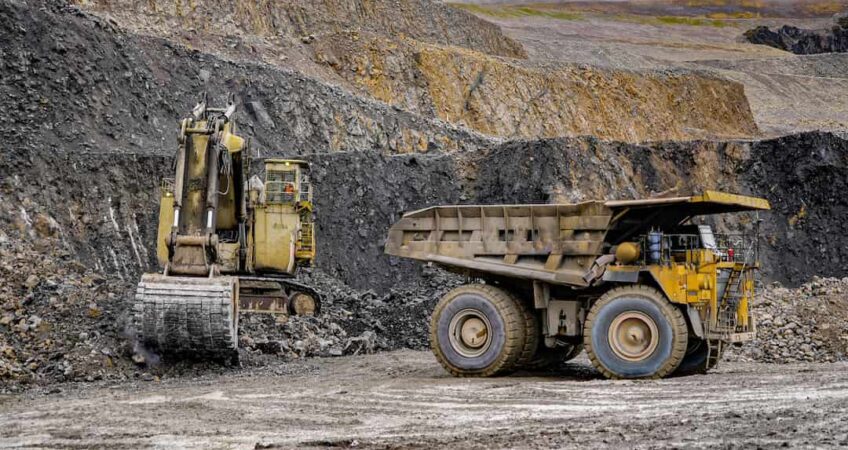
In mining, haulage refers to the process of transporting extracted materials—such as ore, coal, waste rock, or equipment—from the mining site to another location for processing, storage, or disposal. It plays a vital role in both surface and underground operations, and without an effective haulage system in place, production slows, costs rise, and safety risks increase.

The method used depends on several factors, including the type of mine, the volume of material, and the distance between extraction and delivery points. From high-capacity trucks in open-cut mines to conveyor systems and rail networks in large-scale operations, haulage is the link that keeps the mining process moving.

For mining companies, understanding how haulage works—and the challenges it presents—is key to managing productivity, maintaining site safety, and reducing delays.

What Does Haulage Involve in Mining?

Haulage is more than just moving rock. It includes the transport of raw materials, equipment, machinery, and waste between key points on a mining site. These include the pit or underground face, stockpiles, processing plants, workshops, and waste areas.

The goal is to keep material flowing smoothly so the operation runs without delays. Whether it’s hauling ore to be crushed or delivering replacement equipment to a remote site, haulage forms the backbone of mine site logistics.

Types of Haulage Systems in Mining

Mining operations use different haulage methods depending on site layout, terrain, and the nature of the materials being transported. Below are the most common systems used in the industry.

Truck Haulage

Truck haulage is one of the most widely used methods in surface mining. It involves the use of large off-road mining trucks designed to carry heavy loads across rough terrain.

These trucks are flexible, capable of handling large volumes, and easily redirected to meet changing site demands. They are especially effective when haul distances vary or site conditions change over time.

Related reading: Learn more about how these trucks are transported in How Are Mining Trucks Transported.

Conveyor Systems

Conveyors are used when materials need to be moved continuously over long distances. They are ideal for stable, high-volume routes and are often seen in large-scale operations where moving ore from the pit to the plant is ongoing.

Once installed, conveyor systems can reduce the need for truck haulage, lower emissions, and improve energy efficiency.

Rail Haulage

Rail systems are often used in operations with heavy material movement over long, predictable distances. Although less common today due to higher upfront costs, rail can be an efficient solution when transporting large volumes of ore or coal.

Rail is typically used in established mining regions or for connecting mines to remote ports or industrial hubs.

Underground Haulage

In underground mining, haulage is more complex due to space and access limitations. Common systems include:

  • Load-Haul-Dump (LHD) vehicles

  • Rail-based systems

  • Conveyor belts and skips

These methods are compact and designed for narrow tunnels. The chosen method often depends on the depth of the mine, the incline of the drifts, and the production scale.

Why Haulage is Critical to Mining Operations

Cost Management

Haulage can account for a significant portion of a mine’s operating costs—often up to 60% in surface mining. The cost of fuel, labour, equipment wear, and maintenance adds up quickly. Choosing the right haulage method and optimising routes can dramatically reduce these overheads.

When operations are spread across remote areas, efficient planning becomes even more important. Poor haulage decisions can lead to unnecessary delays, budget blowouts, and lost production.

Productivity and Efficiency

Mining relies on consistent material flow. If ore or waste isn’t moved on time, production stalls. Effective haulage systems help avoid these bottlenecks by keeping extraction, transport, and processing aligned.

Whether it’s scheduling truck cycles or integrating conveyor systems, smooth haulage contributes directly to higher daily output and better use of equipment.

Safety Considerations

Mining environments are high-risk. Poorly managed haulage can result in vehicle collisions, load instability, and unsafe interactions between machinery and workers. Investing in trained operators, appropriate equipment, and proper haul road design can reduce incidents significantly.

Haulage to and from remote mining sites also presents added risks. Reliable transport in these areas requires experience and attention to detail. For more on this, see our Mine & Remote Transport service offering.

Challenges in Mining Haulage

Haulage is rarely straightforward. Mining companies face a unique set of logistical obstacles:

  • Remote locations: Many mines operate in isolated regions with limited infrastructure.

  • Weather impacts: Flooding, dust storms, and extreme temperatures can disrupt routes.

  • Overdimensional loads: Moving large machinery or components requires permits, escorts, and detailed planning.

  • Terrain and access: Navigating steep gradients, unsealed roads, and tight clearances demands experience and reliable equipment.

These factors make haulage a strategic function—not just a support task. Partnering with the right provider can reduce risk, improve compliance, and keep projects on track.

Related reading: See our guide on Logistical Challenges in the Mining Industry for more insight.

Choosing the Right Haulage Partner

The success of mining haulage often comes down to who you trust to manage it. A capable logistics partner does more than move materials — they ensure safety, efficiency, and compliance from start to finish.

When selecting a haulage provider, look for:

  • Experience in mining and remote-area transport

  • Capability for overmass and overdimensional loads

  • Strong planning and compliance support

Outsourcing to a dedicated transport partner can also reduce overheads and improve reliability. Learn more in our blog on the Benefits of Hiring a Heavy Haulage Partner.

Final Thoughts

Haulage is more than a support role in mining — it’s a critical function that impacts safety, productivity, and profitability. Understanding how haulage works, what methods are available, and what challenges it presents gives you greater control over your mining operation.

If your project depends on consistent material flow, reliable equipment delivery, or remote-site logistics, a proven haulage provider can make all the difference.