Linehaul transport is the long-distance leg of a freight journey. In road freight, it often connects two depots, distribution hubs or distribution centres. On a Perth-to-Port Hedland shipment, the truck movement between the two depots is the linehaul leg.
Linehaul covers the main transport leg. On a depot-to-depot booking, it starts at the sending depot and ends at the receiving depot.
Transit time depends on what you book. Confirm whether the estimate covers depot-to-depot travel or the full journey from pickup to final delivery.
Site delivery needs its own details. If freight must reach a mine or project site, provide the access point, delivery window and unloading requirements when you request a quote.
Where linehaul sits in a freight journeyExample: Perth to Port Hedland
Pickup
Supplier or sender
Collection
Sending depot
Perth
Linehaul leg
Receiving depot
Port Hedland
Final leg
Final address
Mine or project site
Depot-to-depot transit time
Sending depot to receiving depot
Door-to-door estimate
Pickup, main transport leg and final delivery
How does linehaul transport work?
On a depot-based service, freight moves through three stages. The sender or carrier gets the goods to the sending depot. A linehaul truck moves them to the receiving depot. The receiver then collects the freight, or the carrier arranges delivery if the booking includes it.
Pickup or depot drop-off
The sender can drop the goods at the depot, or a carrier can collect them. If the goods are coming from a supplier, confirm when they will be packed and ready. Check whether the sending depot has a cutoff for freight to make the planned departure.
The linehaul leg
The linehaul truck moves freight between depots. A carrier can combine compatible shipments heading to the same region on one trailer. This is called consolidation. If you only need to move a few pallets, shared trailer space may be suitable. Tell us about any handling restrictions so we can assess whether the freight can travel with other loads.
Collection or final delivery
At the receiving depot, the freight may need to be unloaded and sorted before it is ready for collection or loaded onto another truck for local delivery. Check when the receiver can collect it. If delivery is included, confirm the receiving hours at the final address.
What does the transit time cover?
A depot-to-depot transit time covers the movement between the nominated depots. A door-to-door estimate should account for pickup, the main transport leg and final delivery. Ask which milestones the carrier uses to measure transit time so you can compare quotes on the same basis.
What does “due Thursday” mean?
ThursdayTruck expected at the depot
ThursdayPallet available to collect
ThursdayFreight due on site
If a pallet is due into Port Hedland on Thursday, check whether Thursday means the truck is expected at the depot, the pallet is available to collect, or the freight is due on site. Those are different milestones. If a maintenance crew needs the pallet for a Friday shutdown, give the carrier the site delivery deadline before you book.
Where does linehaul end?
On a depot-to-depot booking, linehaul ends at the receiving depot. Any movement beyond that point depends on the delivery arrangements in your quote.
Depot collection
Suppose you’re sending a pallet of pump spares on our Perth to Port Hedland freight route. If a local contractor will collect it, confirm the depot address and collection window. Give the contractor the consignment reference so they can identify the freight on arrival.
Delivery to a mine site
If the pallet needs to reach a mine site, confirm who will arrange the final leg. A mine name alone may leave the driver with several possible gates or receiving areas. For remote freight delivery, give us the approved access point, site contact and any induction or unloading requirements.
When does direct transport suit?
Pickup to site, no transfers
Direct transport
Direct transport can suit freight that is difficult to transfer between vehicles or needs to arrive within a fixed delivery window. A full truck load gives your shipment dedicated trailer space. If the truck needs to go straight from pickup to site, include that requirement in the quote request.
Depot to depot, shared trailer
Shared linehaul
Shared linehaul services can suit smaller shipments when the freight can be handled at a depot and the timing allows for onward delivery.
If both options could work, give us the same final address and delivery deadline. We can assess the route, handling and access requirements for each option.
What should you confirm before booking?
Confirm where your quote starts and ends, then provide the details that affect each handover.
Linehaul booking checklist
LoadList the number of items, packed dimensions and weight of each item. Flag any special handling requirements.
PickupProvide the collection address, the date the freight will be ready and any loading requirements.
DestinationSpecify depot collection or give the final delivery address, access point and receiving contact.
TimingGive the required collection or delivery window. Flag any shutdown, crew booking or site restriction that affects it.
UnloadingConfirm who will supply a forklift or crane if one is needed.
What is the meaning of line haul?
Line haul means the main long-distance movement of freight between locations such as depots or distribution centres.
Linehaul is another spelling of the same term. On a depot-based road service, it describes the leg between the sending and receiving depots.
Plan your regional freight move
We’re a family-owned WA freight business with depots in Perth and the Pilbara. If your freight needs to go beyond a regional depot, give us the final delivery address and the date it needs to arrive.
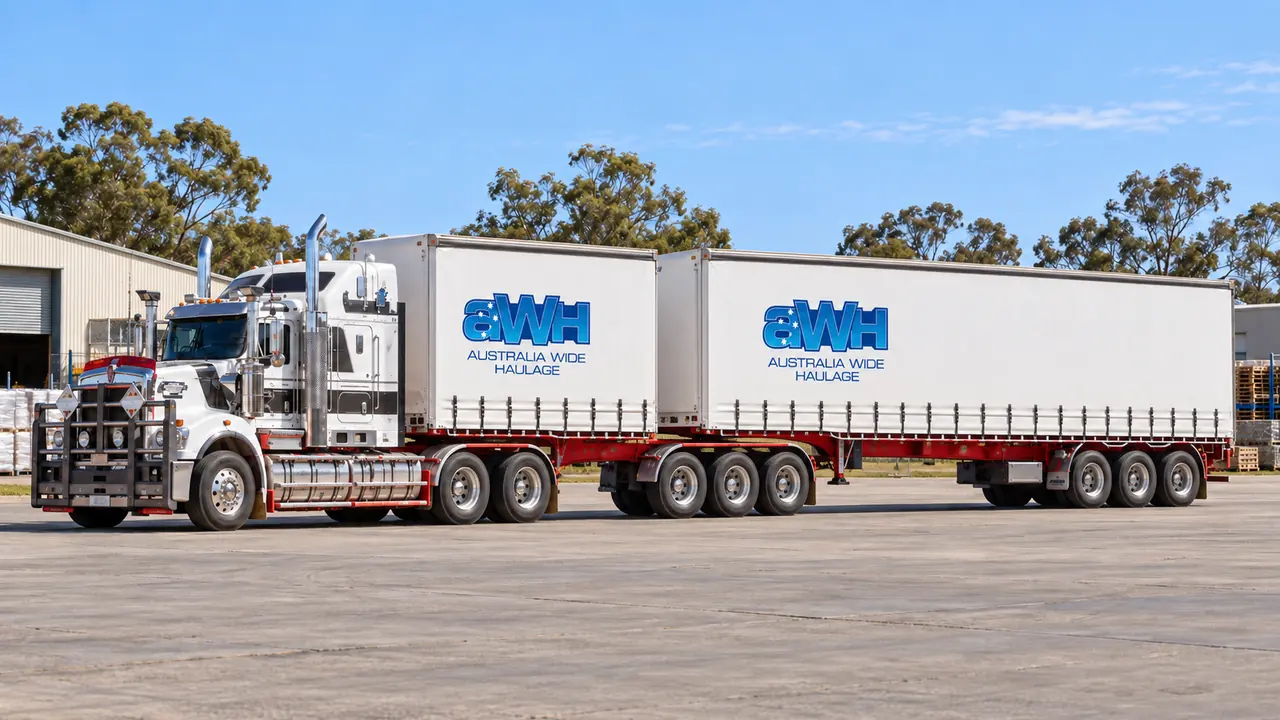
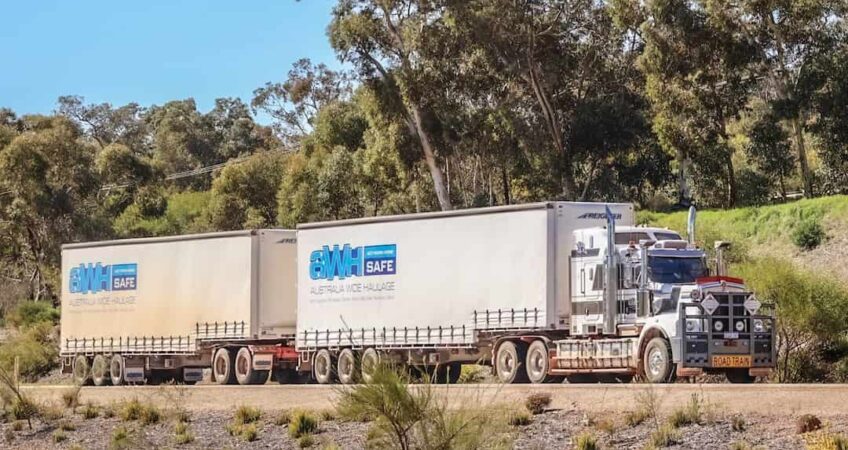
A B-double is a heavy vehicle combination made up of a prime mover and two semi-trailers. The rear trailer connects to a fifth wheel mounted on the lead trailer, creating more loading space than a single semi-trailer in a combination that is shorter than many road trains.
In Western Australia, whether a B-double suits a job depends on the freight, the approved road network and practical access at the collection and delivery sites. Length and mass figures are only the beginning: axle loading, turning space and the complete route also matter.
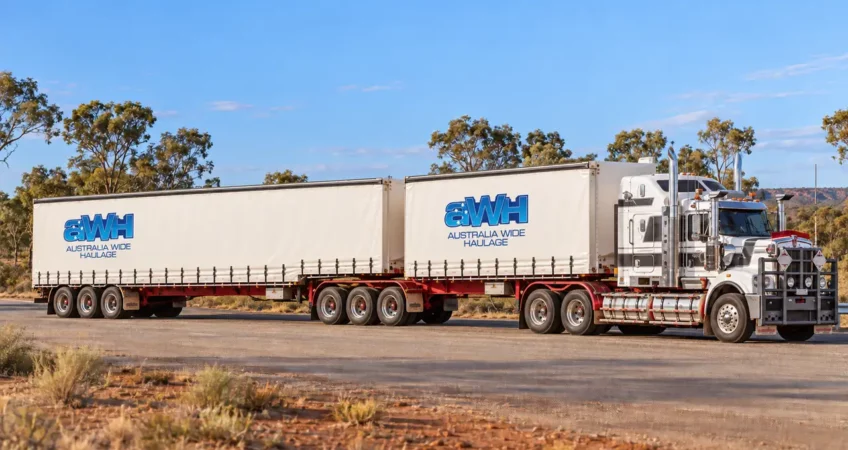
B-double freight · Western AustraliaAn Australia Wide Haulage B-double positioned for freight transport in Western Australia.
Quick summary
A B-double has one prime mover and two semi-trailers joined by fifth wheel couplings.
The “B” describes the coupling arrangement; “double” refers to the two trailers.
In WA, a Category 2C B-double may be up to 27.5 metres long and 72 tonnes total mass, subject to the operating conditions.
B-doubles and road trains are separate heavy vehicle categories with different connection arrangements and access conditions.
An accurate quote needs the freight dimensions and weight, exact addresses, dates and site-access details.
2Semi-trailers behind one prime mover
27.5 mCategory 2C maximum overall length
72 tCategory 2C total mass limit—not freight payload
Why are they called B-doubles?
The letter “B” identifies the way the trailers connect. A fifth wheel on the prime mover supports the lead trailer, while another fifth wheel at the rear of that lead trailer supports the second semi-trailer.
A fifth wheel is the load-bearing coupling plate. The trailer’s kingpin locks into it, allowing the combination to turn while transferring part of the trailer’s mass through the coupling.
B-double configuration showing the prime mover, lead semi-trailer and rear semi-trailer.
Term 01
Fifth wheel
The coupling plate mounted on the prime mover or lead trailer. It carries part of the trailer’s mass and allows articulation.
Term 02
Kingpin
The pin beneath a semi-trailer that locks into the fifth wheel to create the load-bearing connection.
What is the length limit for a B-double in WA?
Under the current Main Roads WA Prime Mover Combinations Operating Conditions, a Category 2C B-double may be up to 27.5 metres overall. A Category 1C short B-double may be up to 20 metres.
Operational detail
The figure is for the complete vehicle combination, not just the trailers. Access also depends on the applicable order or permit, the approved network and any route-specific conditions.
What is the weight limit for a B-double in WA?
A Category 2C B-double has a 72-tonne total mass limit under the current operating conditions. This is the mass of the prime mover, both trailers and the freight combined—it is not the payload available to the customer.
Actual carrying capacity depends on the tare mass of the equipment, axle-group limits, vehicle ratings, freight position and every condition applying to the movement. A combination can remain below the total mass limit and still overload an individual axle group.
For machinery and project freight
Provide the verified weight of the load together with attachments, packing, cradles or transport frames. These items all contribute to total and axle-group mass.
B-double vs road train vs semi-trailer
The clearest difference is the number of trailers and how they connect. A road train may use converter dollies and drawbars, while a B-double uses fifth wheel couplings. Main Roads WA classifies these combinations separately.
Combination
Trailers
Connection
Maximum length
Total mass limit
Single semi (1B)
1
No second trailer
19 m
50 t
B-double (2C)
2
Fifth wheel on lead trailer
27.5 m
72 t
A-double road train (5A)
2
Drawbar and converter dolly*
36.5 m
89 t
B-triple road train (5D)
3
Fifth wheel couplings
36.5 m
89 t
A-triple road train (9A)
3
Drawbars and converter dollies*
53.5 m
127.5 t
*For classification purposes, a converter dolly and the semi-trailer it supports count as one trailer. Figures shown are category limits from the current WA operating conditions; axle configuration, ratings, route access and other conditions still apply.
B-double and A-double trailer connections use different coupling arrangements.
B-double vs semi-trailer
A standard articulated semi-trailer combination has one trailer. A B-double adds a second semi-trailer, increasing usable loading space but also changing the combination’s mass, length, turning path and network-access requirements.
A-double vs B-double
Both have two trailers, but the connection is different. An A-double uses a converter dolly and drawbar between the trailers; a B-double uses a fifth wheel mounted on the lead trailer. See our road train guide for a closer look at common road train configurations.
Where can a B-double travel in WA?
B-doubles do not have unrestricted access to every road. The planned route must be available under the applicable order or permit, and the vehicle must comply with the operating conditions for that access.
01 / NETWORKApproved roadsCheck the relevant RAV network and operating conditions.
02 / LOCALLocal accessConfirm local-government and route-specific requirements.
03 / SITEGate and yardCheck width, turning room, surface, overhead clearance and restrictions.
04 / EXITUnload and departPlan safe unloading, repositioning and the return path.
For Western Australian work, planners use the Main Roads RAV Mapping Tool and the current access requirements. A mapped route still does not replace checking the final approach, gate, yard and unloading area.
Interstate work requires a separate review because vehicle access and operating conditions can change at the border.
When does a B-double make sense?
A B-double can be efficient when the freight needs more deck or body capacity than a single semi-trailer and both the route and sites can accommodate the larger combination. Common applications include:
01 / FREIGHTPalletised goodsHigher-volume freight that can be distributed correctly across both trailers.
02 / PROJECTSBuilding materialsProject loads where consolidated movements can reduce unnecessary trips.
03 / INDUSTRYIndustrial suppliesEquipment and consumables moving between depots, projects and remote sites.
The format is not automatically the best option for every larger load. Machinery may require specialised decks, loading equipment or over-dimensional approvals. A full truck load service can be planned around the freight rather than selecting a vehicle by volume alone.
The right comparison is the cost and risk of the whole movement. Splitting freight, transferring it to smaller vehicles or arranging extra handling for constrained sites can offset the benefit of carrying more on the highway leg.
What information is needed for a B-double quote?
Clear details allow the carrier to assess the combination, route and site requirements before pricing the work.
Quote checklist
Freight description and quantity
Verified weight and dimensions
Packing, frames or attachments
Loading and unloading method
Exact collection and delivery addresses
Preferred dates and time restrictions
Site access, gate and turning details
Contacts and site-entry requirements
Frequently asked questions
What licence is needed to drive a B-double?
In Western Australia, a B-double requires a Multi Combination (MC) driver’s licence. The licence class covers motor vehicles towing two or more trailers when each trailer has a gross vehicle mass greater than 9,000 kg.
Can a B-double carry oversize freight?
It can, but exceeding standard dimension or mass limits changes the movement requirements. The load and combination may need a permit, a prescribed route and other controls under the applicable operating conditions. See our over-dimensional transport service.
Is every two-trailer combination a B-double?
No. The coupling arrangement matters. A B-double uses a fifth wheel on the lead trailer; an A-double road train uses a drawbar and converter dolly between its two trailers.
How much freight can a B-double carry?
There is no single payload figure for every B-double. Payload is the permitted total mass minus the actual tare mass, and it must also comply with axle-group limits, vehicle ratings, freight distribution, route access and operating conditions.
Australia Wide Haulage can assess the freight, route and site requirements and recommend a practical transport setup. Send the load details and both addresses for a job-specific quote.
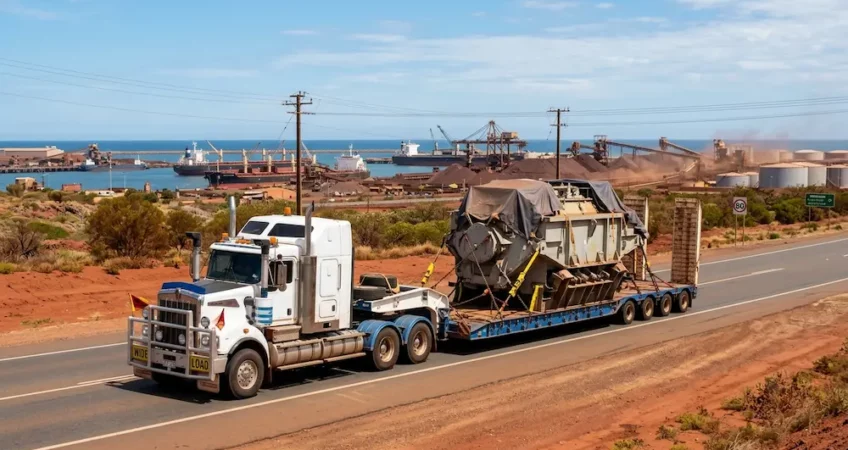
A low loader is a semi-trailer built to carry tall or heavy machinery on a main deck that sits close to the road. The lower carrying position helps manage the total loaded height when moving plant beneath bridges, overhead services and other route constraints.
Low loaders commonly carry excavators, dozers, loaders, graders and industrial plant. The right setup is determined by the machine’s actual dimensions, mass and condition — together with the route, loading method and access at both sites.
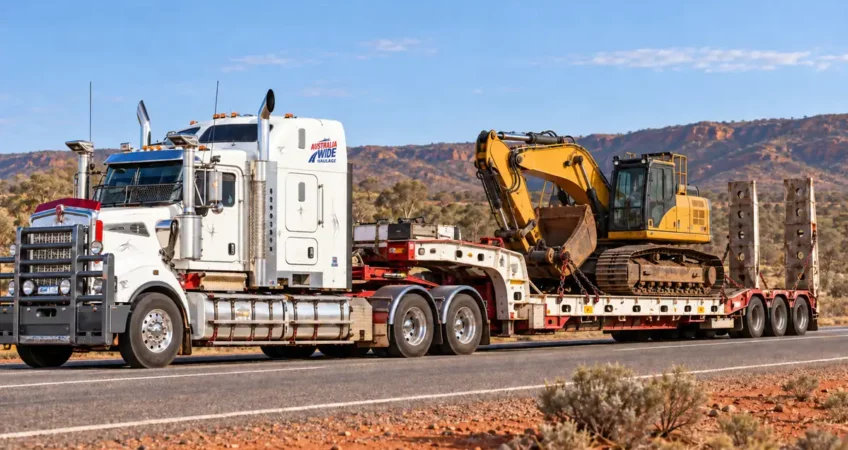
Remote WA transport planning must account for the complete vehicle, route and final site access.
Quick summary
Purpose: carries tall or heavy equipment on a low main deck.
Common loads: excavators, dozers, loaders, graders, rollers and drilling equipment.
Capacity: depends on the trailer, prime mover, axle groups, mass distribution and route.
Remote work: mine-site movements need extra planning for access, site controls, communications and unloading.
Approvals: a permit or order may apply when the complete vehicle and load exceed general access limits.
Quote essentials: provide verified dimensions, mass, attachments, machine condition, locations and dates.
What is a low loader?
A low loader forms part of a heavy vehicle combination. Its main carrying deck sits close to the road surface, placing machinery lower than it would sit on many flat deck or standard drop deck trailers.
Different designs use different deck heights, axle groups and loading systems. Some use hydraulic or fixed ramps; others use a detachable front section. These details affect how machinery is loaded, how its mass is distributed and how the journey is planned.
Low-loader anatomyWhy the deck profile and load position matter
Illustrative · not to scale
01Control loaded heightThe low main deck helps reduce the machine’s overall road height.
02Plan how it gets aboardMachine condition and ground clearance shape the loading method.
03Distribute mass deliberatelyMachine position, axle groups and trailer rating must work together.
You may also hear this type of trailer called a low bed, lowboy or float. These names are not used consistently. Some businesses also use “low loader” and “drop deck” for overlapping designs, even though the deck arrangements can differ.
The trailer’s design and rated configuration matter more than the name used for it.
A low loader can carry many types of heavy equipment and industrial plant when its configuration suits the load. Common applications include:
01Excavators & attachments
02Bulldozers & track loaders
03Wheel loaders & skid steers
04Graders, rollers & compactors
05Drilling & mining equipment
06Crushers, screens & plant
07Agricultural machinery
08Non-running machinery
The machine category alone does not determine the trailer. Two excavators from a similar operating class may have different track widths, counterweights, attachments and transport masses.
Manufacturer specifications provide a starting point, but the actual machine should be checked. Site modifications, attachments and aftermarket components can change its transport dimensions and mass.
Low loader vs drop deck vs flat deck
A low loader usually suits machinery that benefits from a lower carrying position. Drop deck and flat deck trailers serve different height, loading and freight requirements.
Trailer type
Basic configuration
Often considered for
Main planning point
Low loader
Low main carrying deck
Tall or heavy mobile plant
Loaded height, loading method and mass distribution
Drop deck
Upper deck with a lower main deck
Machinery, equipment and general freight
Available deck height and freight flexibility
Flat deck
One open deck above the wheels
Containers, general freight and equipment within height limits
Side and crane access, with a higher deck
Extendable
Deck extends to support longer loads
Long structural or industrial items
Support points, turning and rear overhang
The best option depends on the load, route and collection site. If the correct trailer is unclear, send the machine’s dimensions, mass and loading details to a heavy machinery transport specialist for assessment.
How do we choose a low loader for a job?
We assess the machine, trailer, prime mover, route and sites as one transport task.
01
Verify dimensions and mass
Confirm the machine’s length, width, height and mass in the exact configuration in which it will travel. Attachments may need to be lowered, removed or transported separately.
02
Match the equipment combination
Assess deck length, trailer rating, prime mover and axle groups. Some loads may call for a quad-axle or another multi-axle design to distribute mass appropriately.
03
Check the machine’s condition
A working machine may drive or track onto the trailer. Non-running plant may require a winch, crane or recovery equipment and a different unloading plan.
04
Review the route
Check road access, structures, overhead clearances, turns, gradients and road surfaces. The complete loaded height and width matter throughout the journey.
05
Assess both sites
Confirm gates, turning room, ground conditions, loading space, unloading space and any site-specific controls at collection and delivery.
06
Confirm access requirements
The completed combination, loaded dimensions and proposed route determine whether restricted-access approvals, pilots, escorts or operating conditions may apply.
Australia Wide Haulage operates a modern line-haul fleet with prime movers rated between 90 and 167 tonnes. Those ratings support a range of heavy transport work, but every job still needs its own mass, route and access assessment.
How are loading and unloading handled?
The transport team should load machinery in a controlled area, position it according to the transport plan and restrain it for road travel. The method depends on the machine, trailer and space available.
01
Prepare the area
Confirm firm, level ground where possible and keep other people and vehicles clear of the loading zone.
02
Inspect the equipment
Check the machine, trailer, ramps, deck, restraints and rated attachment points before loading.
03
Load under clear direction
Use an agreed spotter and communication method. Keep people outside travel paths and crush zones.
04
Position and restrain the machine
Place it according to the planned mass distribution, secure movable parts and use restraints and anchor points suitable for the load.
05
Complete final checks
Verify dimensions, restraint, loose items and clearances before departure. Recheck the load during the journey where required.
Load restraint in WA
As at September 2026, the National Transport Commission states that Western Australia’s heavy-vehicle loading requirements are contained in the Road Traffic (Vehicles) Regulations 2014, which reference the 2004 Load Restraint Guide. Requirements should be checked again before each movement.
Do low-loader movements need permits in WA?
A low loader does not require a permit simply because of its trailer type. A permit or order may apply when the complete vehicle and load exceed general access limits.
As at September 2026, Main Roads WA generally identifies a vehicle or combination as a Restricted Access Vehicle (RAV) when it exceeds any of the following limits:
2.5 moverall width
4.3 moverall height
12.5 mrigid vehicle length
19 mcombination length
42.5 tgross mass
Axle and axle-group mass limits also apply. These headline thresholds do not replace an assessment of the vehicle class, network, route and operating conditions.
The Main Roads WA RAV Mapping Tool provides approved networks, heavy-vehicle travel impacts and restricted-structure information. It must be used with current operating conditions and job-specific approvals. Pilot, escort, route or travel-time conditions may also apply.
Important
Access rules, network conditions and permit requirements can change. Confirm the current requirements for the actual vehicle, load and route before committing to a movement.
How are mine-site and remote moves planned?
Mine-site and remote low-loader work needs extra planning for site controls, road conditions, communications and support. Long-distance work also requires realistic fuel, fatigue and contingency planning.
Site inductions, communications, road conditions and unloading arrangements can all shape a remote movement.
Remote movement checks
Sealed, unsealed and private-road access
Seasonal closures and weather conditions
Mine-site inductions and booking windows
UHF channels and call-up points
Journey-management requirements
Fuel range, rest areas and service support
Gate widths and wash-down bays
Unloading conditions and site contacts
The collection and destination contacts should agree on who will load and unload the machine, what support equipment is available and when the site can receive it.
Australia Wide Haulage has experience planning mine and remote transport across Western Australia. Early notice gives the team more time to check the equipment, route, approvals and site requirements.
What affects low-loader transport costs?
Distance matters, but it does not determine the whole price. A reliable quote reflects the work needed to move the machine safely and lawfully.
01Machine dimensions and mass
02Trailer, prime mover and axles
03Route length and access
04Permits, pilots and escorts
05Winches, cranes or recovery
06Collection and delivery sites
07Separate attachments
08Travel windows and deadlines
What information does AWH need for a quote?
Accurate information at the start helps the team assess the trailer, route, loading method and approvals without relying on assumptions.
Low-loader quote checklist
Machine make and model
Verified length, width and height
Transport mass and centre of gravity, where available
Attachments and any removable components
Whether it starts, steers, brakes and self-loads
Collection and delivery addresses
Site contacts and access restrictions
Available loading and unloading facilities
Required dates or delivery windows
Current photos or specification sheets
If a dimension or mass is uncertain, say so. The team can identify what must be checked before the movement is booked.
Low-loader FAQs
How many tonnes can a low loader carry?
There is no universal low-loader capacity. It depends on the trailer design, prime mover, axle groups, load position, route access and applicable permit conditions. The actual machine and complete vehicle combination must be assessed.
Can a non-running machine be moved on a low loader?
Yes, when the carrier can develop a suitable loading, restraint and unloading method. The job may need a winch, crane, towing support or recovery equipment, so disclose the machine’s condition when requesting a quote.
How far ahead should I book a low loader?
Book as early as practical when the load may be oversize, overmass, remote or subject to site controls. More lead time allows the carrier to confirm equipment, assess the route, arrange approvals and coordinate site access.
Is a low loader the same as a lowboy or float?
The terms are often used for similar low-deck machinery trailers, but usage varies between operators and manufacturers. Compare the actual deck arrangement, dimensions, rating, axles and loading system instead of relying on the name alone.
Does every excavator need a low loader?
No. Trailer selection depends on the excavator’s actual transport dimensions, mass, attachments, loading method, route and site access. Some machines may suit another trailer configuration.
Australia Wide Haulage is a family-owned Western Australian freight business with origins dating to 1985. Our team transports machinery and equipment for mining, construction, agricultural and industrial projects.
Send the machine details, locations, access requirements and preferred timing. We’ll assess the trailer, loading method, route and transport requirements around the actual job.
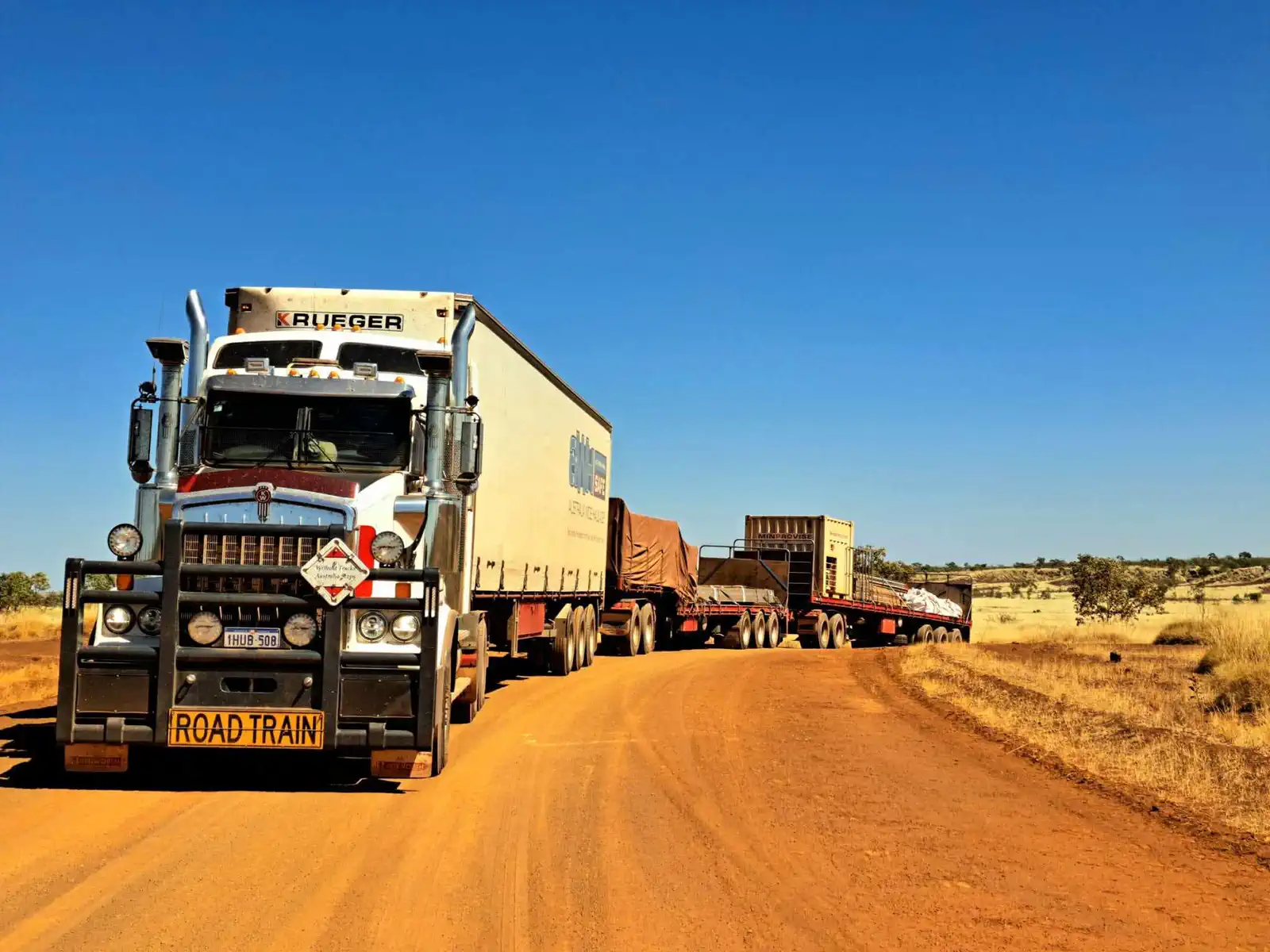
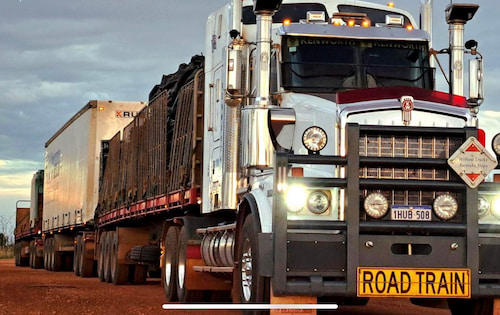
A road train is a prime mover or truck towing two or more trailers. It allows operators to move large freight volumes over long distances.
In Western Australia, road trains carry freight across long regional and remote routes. Main Roads WA requirements determine which configurations can use particular roads and the conditions that apply.
WA freight often travels hundreds or thousands of kilometres. Road trains provide the capacity needed to move larger loads between Perth, regional centres, mine sites, stations and remote projects.
Quick summary
A road train is a prime mover or truck towing two or more trailers to move larger freight volumes over long distances.
Common road train configurations in WA include A-doubles, B-triples, AB-triples, BA-triples and A-triples.
Road train length varies according to the vehicle configuration and Main Roads WA access category. Main Roads advises that road trains operating in WA can range from 27.5 metres to 60 metres.
Different road train combinations can have different mass, axle group and approved road requirements.
Main Roads WA administers the vehicle access system used for Restricted Access Vehicles in Western Australia.
Road trains support mining supply chains, general freight, agriculture, remote deliveries and full truck load freight.
The right combination depends on freight weight, dimensions, road access, loading requirements and the final delivery site.
What is a road train?
A road train is a heavy vehicle made up of a prime mover or truck and two or more connected trailers.
The prime mover provides the power. The trailers provide the freight capacity.
Different trailer and coupling arrangements can sit behind the prime mover depending on the load, route and required carrying capacity.
This means the term road train does not describe one standard truck.
A road train may be a two-trailer combination or a much longer triple or multi-trailer combination travelling on an approved regional route.
In WA, many larger heavy vehicles operate as Restricted Access Vehicles, usually shortened to RAVs.
Main Roads WA manages access for RAVs across the state's public road network. Its Heavy Vehicle Services section manages permits, orders, access requirements, RAV networks and related operating conditions.
Vehicle length, width, height, total mass and axle loads can determine whether additional access requirements apply. For example, Main Roads identifies a combination exceeding 19 metres as one of the thresholds that can require RAV access arrangements.
Choosing the truck is therefore only part of the transport task. The vehicle must also suit the freight, approved route and delivery site.
How do road train configurations work?
Road train configurations differ mainly by the number of trailers and how those trailers connect.
Two terms appear regularly when discussing road train configurations: A-type and B-type connections.
An A-type arrangement generally uses equipment such as a converter dolly between trailer units.
A B-type arrangement connects the next semi-trailer through a fifth wheel positioned on the trailer in front.
These coupling methods create different road train combinations, including A-doubles, B-triples, AB-triples and A-triples.
Configuration
General description
Typical WA category examples
Practical use
B-double
Prime mover with two semi-trailers using a B-type connection
Up to 27.5 m in relevant categories
High freight capacity in a shorter combination
A-double
Prime mover with two trailers using an A-type arrangement
Up to 27.5 m or 36.5 m depending on category
Common regional road train arrangement
B-triple
Three-trailer B-type combination
Up to 36.5 m in relevant categories
Provides additional freight capacity
AB-triple
Three trailers using a mix of A and B connections
Often within 36.5 m categories
Used where the approved network allows
BA-triple
Another mixed three-trailer arrangement
Often within 36.5 m categories
Access depends on the specific RAV category
A-triple
Prime mover towing three trailers using A-type arrangements
Longer categories can extend beyond 36.5 m
High-capacity regional and remote freight
Other combinations
Special-purpose multi-trailer combinations
Depends on vehicle category
Used for particular freight and routes
Main Roads WA publishes specific RAV categories and operating conditions for prime mover and trailer combinations. Maximum dimensions and masses depend on the category rather than the configuration name alone.
A road train has at least two trailers, but the total number depends on the approved configuration and road network.
Common combinations use two or three trailers. Longer specialised combinations can use additional trailer units where the applicable Main Roads WA category and network allow them.
The trailer count alone does not determine whether a vehicle can use a particular route. Overall length, axle groups, mass and configuration also matter.
What does the A or B in a road train configuration mean?
The letter describes the way trailers connect within the combination.
An A connection generally introduces another connection point between the trailers, often using a converter dolly.
A B connection uses a fifth wheel mounted on the trailer in front to connect the next semi-trailer.
The connection type affects the vehicle configuration, turning behaviour and applicable RAV category.
An A-double and B-double can therefore both have two trailers while operating as different combinations.
What is a converter dolly?
A converter dolly is a wheeled coupling unit used to connect a following semi-trailer to the trailer in front.
It gives the following trailer another connection point within an A-type road train configuration.
Converter dollies are an important reason A-type combinations behave differently from B-doubles. Main Roads operating conditions also contain requirements covering dollies, drawbars, trailer gaps and how trailers can move relative to one another.
What is a triple road train?
A triple road train has three trailers, but there are several possible triple configurations.
Common triple configurations
B-triples
AB-triples
BA-triples
A-triples
These vehicles do not automatically have the same length, mass limits or road access.
Main Roads WA also maintains specific access arrangements for some short triple road train combinations.
The exact configuration must therefore be identified before the transport team confirms where the road train can operate.
How long is a road train in Western Australia?
Road train length depends on the configuration and Main Roads WA vehicle category.
Main Roads WA advises road users that road trains operating across the state can range from 27.5 metres to 60 metres. Longer road trains of up to 60 metres operate in regional areas, while combinations of up to 42 metres can also be encountered in the Perth metropolitan area.
Standard prime mover RAV categories include a range of shorter and longer combinations, with specific maximum lengths assigned to each vehicle category.
Approximate length
Examples
Around 27.5 m
B-doubles and shorter A-doubles
Up to around 36.5 m
Longer A-doubles and several triple configurations
Longer regional combinations
Larger triple and other approved road train configurations
Up to 60 m
Longer road trains operating on suitable regional networks
The exact allowable length must be confirmed for the actual vehicle category and network.
Length is only one requirement.
A road train must also comply with applicable axle arrangements, combination masses, vehicle conditions and network access rules.
Some specialised vehicles can operate through Performance Based Standards or other specific access arrangements.
What is the difference between a road train and a B-double?
A B-double is one specific two-trailer combination. A road train is a broader term that can cover several multi-trailer configurations.
The main difference is usually how the trailers connect.
A B-double uses a fifth wheel on the lead trailer to connect the second semi-trailer.
Many traditional road train configurations use an A-type connection with equipment such as a converter dolly.
Road train
B-double
Broad term covering different multi-trailer configurations
A specific two-trailer configuration
Can include A-double, B-triple, AB-triple or A-triple combinations
Prime mover plus two semi-trailers
A-type combinations can use converter dollies
Second trailer connects using a fifth wheel
Longer configurations can extend well beyond a B-double
Shorter than many regional road train configurations
Often used for regional and remote freight
Used where its capacity and route access suit the freight task
Western Australia's vehicle access system for restricted heavy vehicles is administered through Main Roads WA.
For WA road transport, we focus on the exact combination and approved network rather than relying only on labels such as B-double or road train.
Why are road trains used in Western Australia?
Road trains allow large freight volumes to move efficiently across Western Australia's long regional and remote routes.
They can provide a cost-effective road freight option when the freight volume, route and destination make good use of the additional trailer capacity.
A load may leave Perth and travel through the Pilbara or Kimberley before continuing to a mine, station, construction project or remote business.
For suitable freight, a higher-capacity combination can reduce the number of separate vehicle movements needed to move the same volume.
When can a road train make more sense than several smaller trucks?
A road train can make sense when there is enough freight to use the available trailer capacity and the entire route can accommodate the combination.
Potential advantages
Consolidating a large freight volume
Reducing the number of separate vehicle movements
Using dedicated capacity for scheduled freight
Supporting regular regional supply chains
Moving freight efficiently over long road distances
This does not mean a road train is always cheaper or more suitable.
A shorter truck may make more sense where freight volumes are smaller, access is restricted, deliveries are spread across several tight sites or the load requires specialised equipment.
Mining and resources freight
Road trains support mining supply chains that move large freight volumes between depots, regional centres and remote operations.
01Mine supplies
Palletised supplies, consumables and maintenance freight
02Construction materials
Materials supporting mine and civil projects
03Pipe & structural products
Long-distance supply into regional operations
04Equipment components
Parts and components for site operations
05Maintenance freight
Freight supporting planned and ongoing maintenance
06Project supplies
General freight for remote project requirements
Mine site transport involves more than travelling on the highway.
Our team may also need to account for site inductions, arrival procedures, unloading arrangements, fatigue requirements and access within the mine site.
Road trains can be a practical option for full truck load freight when a customer has enough freight to justify dedicated vehicle capacity.
Suitable loads can include palletised products, packaged materials, industrial supplies and other general freight.
Dedicated capacity can reduce unnecessary freight handling and give the transport plan a clearer loading and delivery schedule.
Our full truck load service can be planned around the volume, route and required delivery timing.
Remote WA freight
Road trains suit many remote WA freight movements because regional distances can be substantial.
Their larger capacity can help move more freight through the long-distance section of the journey.
The final delivery still needs careful planning.
Mine access roads, station tracks and project sites can have tighter corners, limited turning areas or different vehicle access requirements.
Our remote delivery freight service considers the highway journey and final delivery location.
Agriculture and station supplies
Agricultural and pastoral businesses regularly need supplies moved into regional WA.
Freight may include:
Feed
Fencing materials
Consumables
Machinery parts
Packaged goods
Other station supplies
Road trains can provide useful capacity where the freight volume and available road networks support the combination.
Station access, road condition, turning room and unloading facilities still need to be confirmed.
Construction and infrastructure freight
Construction and infrastructure projects can create steady demand for high-volume road freight.
Typical freight may include construction materials, packaged components and project supplies.
Road trains can handle the volume portion of these movements.
Heavy machinery, wide equipment and long indivisible loads may need specialised heavy machinery transport instead.
Where can road trains travel in WA?
Road trains can travel on approved roads that form part of the relevant Restricted Access Vehicle network.
Main Roads WA individually assesses road networks to determine whether they are suitable for particular RAV combinations. Different road train configurations can therefore have different approved networks.
Access for one combination does not automatically apply to another.
For example, a road may accept a shorter combination while restricting a longer triple road train.
This matters when freight leaves a major highway and travels towards:
Final destination access
A mine site
Industrial estate
Station
Construction project
Remote community
Regional depot
Private access road
Project access road
The final part of a route can determine whether a particular road train is practical.
For freight moving into the Pilbara, the main highway may allow a combination while the final delivery point needs a different access assessment.
Our freight transport in Karratha service is one example where regional planning can extend beyond the main highway.
Do road trains only operate in remote Western Australia?
No. Longer road trains are strongly associated with regional WA, but road trains also operate within metropolitan areas.
Main Roads WA states that longer combinations of up to 60 metres operate solely in regional areas, while road trains up to 42 metres are commonly encountered in the Perth metropolitan area.
The actual roads available still depend on the RAV combination and approved network.
Does being on a major highway guarantee road train access?
No. A major highway does not automatically allow every road train configuration.
Access depends on the RAV network and vehicle category.
Individual roads may also have conditions involving:
Bridges
Intersections
Turning movements
Speed limits
Local restrictions
Temporary access conditions
Main Roads requires operators and drivers to check current network information and Heavy Vehicle Travel Impacts before operating a RAV.
Flooding, roadworks, bushfires and other disruptions can also affect road trains operating in regional WA.
How do road trains turn and manoeuvre?
Road trains need more space than smaller vehicles to turn because their length and multiple connection points affect the path taken by each trailer.
At intersections and roundabouts, a truck may need to swing wider or use additional road space to complete the turn safely.
Main Roads WA tells motorists not to overtake a truck displaying a Do Not Overtake Turning Vehicle sign while it is completing a turn. Other road users should leave space and wait for the truck to finish the manoeuvre.
The loading yard or delivery site still needs enough room for the selected road train to manoeuvre.
This turning requirement also affects freight planning.
A road may technically form part of an approved network, but the loading yard or delivery site still needs enough room for the selected combination to manoeuvre.
How should a road train movement be planned?
A road train movement should be planned before dispatch around the freight, vehicle, route and delivery site.
The largest available combination is not automatically the right one.
A shorter vehicle may provide enough capacity while giving better access at the final destination.
01
Confirm the freight requirements
Start with accurate information about the load.
We need to understand:
Freight type
Total weight
Individual item weights
Dimensions
Pallet or package count
Loading method
Unloading method
Restraint requirements
Whether any items are indivisible
Freight volume and weight both affect vehicle selection.
A trailer can reach its legal mass before all available deck or cubic space is filled.
02
Decide whether a road train suits the load
Road trains generally suit high-volume freight travelling significant distances.
They are not the right vehicle for every large load.
Heavy machinery, wide equipment and long indivisible components may need specialised transport equipment instead.
The transport solution needs to suit the actual freight rather than simply provide the most trailer capacity.
03
Select the road train configuration
The next step is choosing the right combination.
B-double
A-double
B-triple
AB-triple
A-triple
Another suitable freight vehicle
More trailers do not automatically make the movement more efficient.
Vehicle selection should balance carrying capacity with road and site access.
04
Confirm RAV route access
The proposed road train should be checked against the current Main Roads WA RAV network.
This assessment needs to cover the full journey.
Checking only the highway can create problems if the vehicle cannot reach the final mine road, industrial estate, station or project site.
Main Roads also requires operators to check Heavy Vehicle Travel Impacts immediately before operating on the public road network.
05
Check permits and operating requirements
Restricted Access Vehicles must operate under the applicable Main Roads access arrangements.
Requirements may depend on:
Vehicle configuration
Overall length
Width
Height
Axle group
Gross vehicle mass
Combination masses
Route
Operating conditions
Current Main Roads WA requirements should be checked for each movement.
06
Plan weight distribution and load restraint
Freight needs to sit correctly across the combination.
Poor weight distribution can affect:
Axle loading
Stability
Mass compliance
Handling
Main Roads operating conditions specify axle-group mass and spacing requirements for relevant combinations.
The transport team also needs to consider restraint points, trailer sequence and unloading order.
Where freight has multiple destinations, the loading plan should reflect the delivery sequence.
07
Confirm site access and unloading
The destination needs enough room for the road train to enter, position and leave.
Remote and project deliveries may require checks covering:
Gate access
Entrance width
Turning areas
Site inductions
Unloading equipment
Ground condition
Waiting areas
Delivery windows
Site contacts
A road train may travel hundreds of kilometres without issue, then face its biggest access challenge at the final delivery point.
08
Check road and weather conditions
WA road conditions can change quickly.
Flooding, cyclones, bushfires, roadworks and temporary restrictions can affect regional road transport.
Main Roads states that RAV networks and operating conditions can be amended and requires operators to use current network information.
This matters most for remote and northern WA freight, where alternative roads may be limited.
Australia Wide Haulage plans regional and remote freight around the load, route and final destination.
We are a family-owned WA freight business with origins dating back to 1985 and have operated as Australia Wide Haulage since 2010.
Our team has experience transporting freight to mine sites and remote areas across WA.
We also operate a modern line haul fleet with prime movers rated from 90 to 167 tonnes. Our trained drivers are supported by maintained trucks, trailers and transport equipment.
What rules apply to road trains in Western Australia?
Road trains operating as Restricted Access Vehicles must follow the Main Roads WA requirements that apply to their combination and route.
Depending on the movement, these requirements can cover:
Potential requirements
Permits or operating orders
Approved RAV network access
Vehicle dimensions
Axle group limits
Combination masses
WA Heavy Vehicle Accreditation requirements
Driver licence requirements
Speed limits
Following distances
Other operating conditions
WA Heavy Vehicle Accreditation is mandatory for operators requiring a permit or order to perform transport tasks for hire or reward in WA unless an exemption applies.
A B-double, short triple and longer A-triple should not be treated as having the same access or operating requirements.
Main Roads may also impose road-specific conditions or temporarily restrict access when road or traffic conditions are unsuitable.
Some specialised heavy vehicles may operate through Performance Based Standards or other specific access arrangements.
Current requirements should always be checked against the actual vehicle, freight and route before movement.
Current requirements
Road train access, permits, RAV networks, dimensions and operating conditions can change. Confirm the current Main Roads WA requirements for the specific vehicle combination, freight and route before movement.
Road train FAQs
What licence do you need to drive a road train in Western Australia?
A Multi Combination, or MC, licence is required for heavy combinations towing two or more trailers where each trailer has a GVM greater than 9,000 kg. Transport WA states that applicants must have held a C class licence for at least three years and an HR or HC licence for at least one year before upgrading.
Applicants must also complete and pass the required practical driving assessment through an approved registered training organisation.
How do road trains brake safely with several trailers?
Road trains need substantially more stopping room than smaller vehicles because of their size and mass.
Main Roads WA advises other motorists not to cut closely in front of a RAV because the heavy vehicle driver may not have enough space to stop safely if sudden braking is required. Poor weather can increase the required stopping distance further.
The exact braking and stability systems depend on the vehicle and trailer setup, so individual combinations need to meet the applicable vehicle and operating standards.
How should motorists safely overtake a road train?
Motorists should be patient and wait for a long, clear section of road or an overtaking lane before attempting to pass.
The WA Road Safety Commission recommends staying several car lengths behind while preparing to overtake, ensuring there is a long stretch of straight road ahead and only returning to the left lane when both truck headlights are visible in the rear-view mirror. Drivers towing caravans or trailers should consider waiting for an overtaking lane rather than attempting the manoeuvre in less suitable conditions.
Main Roads also advises motorists never to overtake a turning heavy vehicle displaying a Do Not Overtake Turning Vehicle sign.
What speed can a road train travel in Western Australia?
Road trains are generally limited to a maximum of 100 km/h because they are vehicles towing trailers, while some larger road trains have a 90 km/h limit. Lower limits can also apply on individual roads or to particular RAV categories.
The applicable speed limit for the vehicle and road must always be followed.
Are road train rules the same throughout Australia?
No. Heavy vehicle access and road train rules can differ between jurisdictions.
This article focuses on Western Australia, where Main Roads WA manages RAV networks, permits, orders and access requirements.
Road train dimensions or access conditions published for the Northern Territory, South Australia or another jurisdiction should not be assumed to apply in WA.
Can a road train carry oversized freight?
A road train may transport some larger freight, but an oversized or overmass load can trigger separate access requirements.
Oversize and overmass movements are regulated according to the load, vehicle, dimensions, mass and route. Main Roads WA maintains separate OSOM permit arrangements for relevant heavy vehicle movements.
Where machinery or equipment falls outside standard freight dimensions, our over-dimensional transport service may be a more appropriate transport pathway.
Need to move road train freight in Western Australia?
Road trains provide substantial freight capacity across WA's regional and remote routes, but the right combination depends on more than trailer count.
The freight, vehicle configuration, road network, axle loads, overall mass, site access and unloading requirements all need to work together.
Australia Wide Haulage supports freight movements across mining, construction, agriculture, industrial projects and remote areas throughout WA.
Contact our team to discuss your freight volume, route and timing requirements and determine a suitable transport setup.
The Port Hedland logistics hub at Lumsden Point gives Pilbara freight a more direct port pathway into the north west. It will support Port Hedland freight, direct shipping, critical minerals freight and renewable energy infrastructure transport — but large loads still need route planning, permits, escorts and site access checks.
For any Pilbara business moving machinery, mine site freight or project cargo, the Lumsden Point logistics hub is a genuine long-term transport improvement. What it isn't is a replacement for proper freight planning.
Quick Summary
Lumsden Point is a new logistics hub at the Port of Port Hedland, built to support new cargo pathways across the Pilbara.
Pilbara Ports Authority has linked the project to lithium and copper concentrates, mineral resources and renewable energy infrastructure.
Pilbara freight transport may become more direct as port facilities and shipping services expand.
Heavy haulage movements will still need the right equipment, permits and route planning.
Over-dimensional loads, remote freight and road train movements will still depend on access, weather, laydown space and site readiness.
What is the Lumsden Point logistics hub?
Lumsden Point is a new multi-user port facility at the Port of Port Hedland, developed to improve cargo capacity and support trade growth across the Pilbara region. The project supports broader Port Hedland logistics by giving freight operators, mining companies and project teams more options for imports, exports and cargo staging.
This matters because Port Hedland has long supported mining and bulk export activity. Lumsden Point adds capacity for different freight types — project cargo, modular freight, wind components, mineral resources, general cargo and electric vehicle supply chain inputs.
For Pilbara logistics, the key point is simple: cargo arrival is only the first stage. Freight still needs to move by road to Wedgefield, mine sites, construction projects, Karratha, inland Pilbara sites and remote WA destinations.
How will Lumsden Point change Pilbara freight?
Lumsden Point will change Pilbara freight by giving some cargo a closer entry point into the region. This may reduce reliance on long-haul freight from southern ports, depending on the cargo, project location and shipping services available.
The Western Australian Government and state government have supported common-user port upgrades in the Pilbara, designed to support future trade, mining, renewable energy and industrial freight demand. For freight planning, the main question isn't just where cargo arrives — it's how that cargo moves from the port to the final site.
01Direct shipping
More direct Pilbara freight options into the region
02Project cargo
Larger modules moving through Port Hedland
03Road train access
Into industrial areas and laydown yards
04Renewable infrastructure
Wind, solar, battery and transformer transport
05Critical minerals
Lithium and copper concentrate movement
06Supply chain planning
Long-term north west freight strategy
Better port access can reduce pressure in the supply chain. It doesn't remove the need for transport solutions that account for load size, route conditions, unloading access and timing.
What freight will be most affected?
The freight most affected by Lumsden Point will likely include project cargo, heavy machinery, renewable energy infrastructure, battery metals, mine site equipment, general cargo and remote supply freight.
Project cargo may include large modules, tanks, construction components and industrial equipment. Heavy machinery may include civil plant, mining equipment and specialist parts that need low loaders or other heavy haulage equipment. Renewable energy freight may include wind, solar, battery and transformer components — loads that can be long, heavy or difficult to handle. Critical minerals freight may include lithium and copper concentrates moving between mine, port and processing supply chains.
Remote freight WA may also benefit, since some cargo can now enter the region closer to inland mine sites, stations and project locations.
How will this affect Pilbara mining logistics?
Lumsden Point should support Pilbara mining logistics by improving port access for equipment, mineral resources, critical minerals freight and mine supply chains — giving mining companies another pathway for Port Hedland mining freight and mine site delivery.
Mining freight depends heavily on timing. Parts, machinery and project cargo often need to match shutdown dates, crane bookings, crew rosters and site access windows. If a loader, drill rig component or module arrives late, the delay can affect contractors, cranes, crews and production planning.
"Cargo arrival is only the first stage."
Key planning points
Cargo release times
Laydown space
Road train access
Mine site entry rules
Delivery windows
Escort requirements
Unloading equipment
Route conditions
As a WA freight operator with mine site and remote-area experience, we plan these details before the truck arrives — reducing avoidable delays once the freight itself is ready to move.
Why heavy haulage planning still matters
Better port facilities don't change the size, weight or risk profile of large freight. Port Hedland heavy haulage still needs the right trailer, an approved route, a permit, an escort plan and careful delivery timing.
An oversize load may be too wide, high or long for normal road movement. Overmass freight exceeds standard weight limits. These dimensional loads can include wind turbine blades, excavator parts, crushers, screens, tanks, drill rigs, power equipment and industrial modules — and the route may include bridges, tight turns, traffic islands, roadworks, overhead structures or mine site access points.
This is where over-dimensional transport planning matters. For heavy plant and mining equipment, our heavy machinery transport service is also relevant — many Lumsden Point freight movements will need low loaders, drop decks, extendable trailers, road trains or other specialist equipment.
What this means for remote freight WA
Lumsden Point may improve remote freight WA options by giving some cargo a closer entry point into the Pilbara — helping freight move from Port Hedland into remote mine sites, stations, construction areas and industrial projects.
Remote freight isn't only about distance. It also involves access, road conditions, fuel, rest planning, site rules and communication. A remote delivery may involve unsealed roads, limited unloading equipment, restricted access gates, changing weather, mine site instructions and permit conditions.
For remote deliveries beyond Port Hedland, our remote delivery freight service supports businesses planning across regional and remote WA. Longer regional freight, such as Port Hedland to Kununurra and Port Hedland to Karratha routes, may also become more relevant as cargo moves between port areas, industrial yards, workshops and project sites.
What to prepare before moving freight through Lumsden Point
Businesses should have clear cargo, route, access and unloading details ready before moving freight through Lumsden Point. Before requesting a quote, confirm:
Pre-quote checklist
Pickup point and cargo release details
Load length, width, height and weight
Cargo type and handling requirements
Standard, oversize or overmass status
Trailer type needed
Destination and delivery window
Permit and escort needs
Laydown or staging needs
Crane, forklift or telehandler access
Site induction or mine access rules
The earlier these details are ready, the easier it is to plan a safe and efficient freight movement.
How AWH supports Pilbara freight through Port Hedland
We help businesses plan and move freight from port, depot or laydown area to final destination — heavy machinery, over-dimensional loads, mine site freight, full truck loads and remote deliveries. We're a family-owned WA freight and logistics company with experience across mine sites and remote areas throughout the state, and a fleet of modern line haul prime movers rated from 90 to 167 tonnes.
Lumsden Point is a major change for Port Hedland freight — a logistics hub focused on direct shipping, critical minerals, renewable energy infrastructure and project cargo. For Pilbara freight, that means more options through the Port of Port Hedland, and more demand for practical transport planning across heavy haulage, remote freight, mine site delivery and over-dimensional transport.
AW
Australia Wide Haulage
Heavy haulage, freight transport & trucking solutions — Hazelmere, WA
A load is considered over dimensional when the vehicle and its load exceed the standard legal size limits for road transport. This may happen because the load is too wide, too high, too long, or creates an overhang that affects how safely it can move on public roads.
In Australia, over-dimensional transport is common across mining, construction, agriculture, infrastructure and remote project work. Large machinery, transportable buildings, tanks, long steel, renewable energy components and oversized equipment often need more than a standard truck and trailer.
The key point is that the full loaded vehicle must be assessed, not just the item being moved. A machine may seem manageable while sitting on site, but once it is loaded onto a trailer, the total height, width, length or weight may trigger additional transport requirements.
At Australia Wide Haulage, we regularly move freight where size, access and compliance need to be planned before the truck leaves site. Understanding what makes a load over dimensional is the first step in choosing the right over-dimensional transport method, route, permits and support vehicles.
What Does Over Dimensional Mean?
Over dimensional means the loaded vehicle is larger than the standard size limits allowed for general road transport. It usually refers to a load that exceeds the permitted width, height, length, rear overhang or projection limits.
This is different from standard freight, where the goods fit within normal truck and trailer dimensions. With over-dimensional freight, the size of the load changes how the vehicle uses the road. It may need more lane space, more turning room, extra height clearance or a route that avoids certain bridges, powerlines and restricted roads.
It is also important to understand that over dimensional does not always mean overweight. A load can be over dimensional because it is too wide or too tall, even if it is not especially heavy. On the other hand, a load can be overmass without being over dimensional.
For example, an excavator with wide tracks may become over dimensional once loaded onto a trailer. A long steel beam may exceed length limits. A transportable building may be too wide for standard road movement. Each load needs to be checked based on its actual loaded dimensions, not assumptions made from its appearance on site.
Standard Heavy Vehicle Dimension Limits in Australia
The standard dimension limits help determine whether a load may be classed as over dimensional. These limits are based on the size of the vehicle and its load together, not the freight item on its own.
As a general guide, many heavy vehicles in Australia are limited to:
Dimension
Common general limit
What this means in practice
Width
2.5 metres
A load wider than this may be considered overwidth
Height
4.3 metres
A taller loaded vehicle may need clearance checks and approval
Length
19 metres
Longer combinations may need restricted access approval
Gross mass
42.5 tonnes in WA RAV guidance
Heavier loads may trigger overmass or restricted access requirements
These figures are a starting point, not the full rulebook. Some vehicle types and combinations have different permitted dimensions. Some movements can also operate under specific notices, orders, networks or permits.
Western Australia has its own Restricted Access Vehicle permit and order system through Main Roads WA. In many other states and territories, heavy vehicle access is managed under the Heavy Vehicle National Law framework through the National Heavy Vehicle Regulator.
This is why early planning matters. A load that is legal on one vehicle, route or permit arrangement may not be legal in another. Before transport is arranged, the loaded width, height, length, mass, route and state requirements all need to be checked.
For businesses moving heavy or oversized freight across WA, this is one of the reasons heavy haulage planning in WA is so important.
What Are the Main Ways a Load Becomes Over Dimensional?
A load can become over dimensional in several ways. In most cases, the issue is not just the size of the item itself, but how that item sits once it is loaded onto the truck or trailer.
The most common triggers are width, height, length, overhang and mass. Each one affects transport planning in a different way.
The Load Is Too Wide
Width is one of the most common reasons a load becomes over dimensional. Machinery, tanks, site buildings, agricultural equipment and construction materials can easily exceed standard road width once loaded.
A wide load may need more lane space, careful traffic management and a route that avoids narrow roads, tight bridges or limited shoulder clearance. Depending on the width and route, pilot or escort vehicles may also be required.
Common examples include:
Excavators with wide tracks
Dozers with blades attached
Large tanks
Transportable buildings
Agricultural machinery
Industrial equipment
For these loads, the goal is not only to fit the freight on the trailer. The movement must also be safe, compliant and practical across the full route. This is especially important for heavy machinery transport, where the load’s working size can make road movement more complex.
The Load Is Too High
Height becomes an issue when the total loaded height exceeds the standard limit for road transport. This includes the height of the trailer, the load itself and any attachments that remain fitted during transport.
Overheight loads need careful planning because they can create clearance risks along the route. Bridges, gantries, powerlines, trees, rail crossings, workshop doors and site entrances can all become obstacles if the loaded height has not been checked properly.
Common examples include:
Tall machinery
Industrial tanks
Silos
Large site sheds
Plant equipment
Boats on trailers
Oversized containers or modules
In some cases, the right trailer can reduce the total travel height. A drop deck trailer or low loader may help keep the load lower to the road, which can improve clearance and reduce route restrictions.
The important measurement is the loaded height from ground level. A machine that appears acceptable while sitting on site may become overheight once it is placed on a trailer.
The Load Is Too Long
Length becomes a problem when the total vehicle combination exceeds the standard length allowed for general road transport. This may be caused by the load itself, the trailer required to carry it, or the full truck and trailer setup needed to move it safely.
Long loads can create challenges that are not obvious at first glance. They may need more space to turn, more room to enter and exit sites, and a route that avoids tight intersections, roundabouts, narrow streets or sharp bends.
Common examples include:
Long steel beams
Pipes and poles
Bridge components
Wind turbine blades
Precast construction materials
Long machinery attachments
Oversized structural components
For these movements, the question is not only whether the load fits on the trailer. We also need to consider how the vehicle will move through the road network, turn into site, avoid roadside hazards and reach the delivery point without creating unnecessary risk or delay.
This is common in major project work, where freight may include long structural components, prefabricated assets or specialised equipment. These types of movements often support broader infrastructure delivery, as explained in our article on how heavy haulage supports major infrastructure projects.
The Load Has Excessive Overhang or Projection
A load may also become over dimensional because it projects too far beyond the vehicle or trailer. This can include rear overhang, front projection or side projection.
Overhang matters because it changes how the vehicle behaves on the road. A projecting load can affect turning, braking, visibility, rear clearance and how safely other road users can pass or follow the vehicle.
Common examples include:
Long beams or pipes
Machinery arms or booms
Equipment attachments
Poles or structural steel
Loads that extend beyond the rear of the trailer
Even if the load is not especially wide or high, excessive projection can still create safety and compliance issues. Depending on the load and route, additional warning equipment, signage, lighting, flags or permit conditions may be required.
This is why every part of the load needs to be measured before transport. The overall dimensions of the loaded vehicle are what determine the planning requirements, not just the main body of the freight.
The Load Is Also Overmass
Over dimensional and overmass are related, but they are not the same thing. Over dimensional refers to size. Overmass refers to weight.
A load may be overmass if the vehicle and load exceed the standard gross mass, axle mass or bridge loading limits. This can happen with heavy machinery, mining equipment, industrial plant, large generators, transformers or dense construction materials.
Some loads are over dimensional but not overmass. Others are overmass but fit within standard dimensions. Many heavy haulage movements involve both, which means the job needs to be assessed from a size and weight perspective before transport begins.
Overmass loads require careful planning because weight affects more than the truck. It can influence trailer selection, axle configuration, road access, bridge restrictions, braking performance, loading requirements and permit conditions.
Before moving a heavy item, we need to understand both the physical dimensions and the mass of the load. This helps determine whether standard transport is suitable or whether restricted access, specialist trailers or additional approvals are required.
If you are unsure whether your freight sits in this category, our guide on what classifies as heavy equipment for heavy haulage explains the types of machinery and equipment that often need specialist transport.
Over Dimensional vs Oversize vs Overmass: What Is the Difference?
Transport terms can become confusing because over dimensional, oversize, overmass and OSOM are often used in the same conversation. They are connected, but they do not always mean the same thing.
Term
What it means
Simple example
Over dimensional
The loaded vehicle exceeds standard size limits
A wide excavator on a trailer
Oversize
A common industry term for a load over standard dimensions
A long steel beam or large tank
Overmass
The loaded vehicle exceeds standard weight limits
Heavy mining machinery
OSOM
Oversize and/or overmass
Equipment that is both wide and heavy
In everyday transport discussions, “oversize” and “over dimensional” are often used in a similar way. The important point is to confirm exactly which limit has been exceeded.
A load that is too wide may need different planning than a load that is too high. A load that is too heavy may require different trailer, axle and route checks again. When a load is both oversize and overmass, the planning becomes more involved because the job needs to account for size, weight, road access and permit conditions together.
This is why we assess the full vehicle and load combination before making transport recommendations. The correct approach depends on what makes the load restricted in the first place.
When Does an Over-Dimensional Load Need a Permit?
An over-dimensional load may need a permit when the vehicle and load exceed the standard limits for general road use. This can apply to width, height, length, mass, overhang or the type of vehicle combination being used.
A permit may also be needed when the load cannot move under an existing notice, order or approved access arrangement. In simple terms, if the loaded vehicle does not fit within standard road rules or approved networks, the movement needs to be assessed before it can go ahead.
Permit requirements can be triggered by:
Loads wider than the standard legal width
Loads higher than the standard legal height
Long vehicle combinations
Excessive rear, front or side projection
Loads that exceed gross mass or axle mass limits
Routes with bridges, rail crossings or overhead hazards
Roads that are not approved for restricted access vehicles
Loads that require pilot or escort vehicles
Movements through regional towns, urban areas or remote roads with limited access
A permit is not just paperwork. It confirms whether a vehicle and load can use a particular route under specific conditions. These conditions may include approved roads, travel times, speed limits, warning signs, lighting, pilot vehicles, escort requirements and bridge restrictions.
In Western Australia, over-dimensional and restricted access movements are managed through Main Roads WA. In many other Australian states and territories, heavy vehicle access is managed under the Heavy Vehicle National Law framework.
For businesses, the safest approach is to check permit requirements early. Waiting until the load is ready to move can create delays, especially if the route needs to be assessed, escorts need to be organised or a different trailer is required.
Why Over-Dimensional Loads Need Careful Route Planning
Over-dimensional loads need more route planning than standard freight because their size can affect how safely and legally they move through the road network. It is not enough to know the pickup point and delivery point. The full route needs to be suitable for the vehicle, trailer and loaded dimensions.
A route that works for a standard truck may not work for an over-dimensional load. The vehicle may need extra turning room, wider roads, better shoulder clearance, higher overhead clearance or access to approved restricted routes.
Route planning may need to consider:
Road width and lane space
Bridge height and weight restrictions
Powerlines and overhead structures
Rail crossings
Roundabouts and tight turns
Roadworks and temporary closures
Traffic volume and travel time restrictions
Road surface condition
Weather conditions
Regional and remote access roads
Mine site or project site entry points
Loading and unloading space at each end
For many jobs, the most direct route is not always the best route. A longer route may be safer, more compliant or more practical if it avoids low bridges, narrow sections, tight town centres or roads that are not approved for the loaded vehicle.
Route planning can also affect cost. Detours, escort requirements, restricted travel windows and fuel usage can all influence the final transport price. We cover related cost factors in our article on how oil prices affect logistics and freight costs.
At Australia Wide Haulage, we look at how the load will move through each stage of the journey. That includes leaving the pickup site, travelling through the approved route and entering the delivery site safely.
Pilot and escort vehicles may be required when an over-dimensional load needs extra support to move safely through public roads. The requirement depends on the size of the load, the route, the state or territory, and the conditions attached to the movement approval.
A pilot vehicle helps warn other road users that a large load is approaching. It can also assist with traffic awareness, road positioning and clearance through tighter sections of the route.
For larger or more complex movements, escort vehicles may also be required. In some cases, police escorts may be needed, particularly where the load affects traffic flow, uses more road space or requires controlled movement through certain areas.
Pilot and escort requirements may be influenced by:
The width of the load
The length of the vehicle combination
The route being used
The time of travel
Traffic conditions
Road width and shoulder clearance
Bridge, rail or infrastructure restrictions
Permit conditions
Local road authority requirements
These vehicles are not just an added formality. They help manage the extra risk created by a load that is wider, longer, slower or less manoeuvrable than standard freight.
For businesses planning an over-dimensional move, escort requirements should be checked early. They can affect timing, cost, availability and how the movement is scheduled.
Our guide to heavy haulage escort vehicles explains how these support vehicles help keep oversized movements safer and more controlled.
Common Examples of Over-Dimensional Loads
Over-dimensional loads are common across industries where equipment, materials or structures are too large for standard transport. In many cases, these items are designed for worksite performance, not easy road movement.
This is why so many sectors depend on specialist heavy haulage. Mining, agriculture, construction, civil works, energy, infrastructure and marine industries all rely on transport providers that understand large and difficult freight. We cover this broader industry demand in our article on what industries rely most on heavy haulage in Australia.
Mining and Civil Equipment
Mining and civil equipment often becomes over dimensional because of its size, width or operating attachments. Excavators, dozers, loaders, graders, drill rigs, crushers and screens may all need specialist transport once loaded onto a trailer.
Even when attachments can be removed, the loaded dimensions still need to be checked before transport.
Mining transport can also involve remote access, strict site requirements and equipment that needs careful planning from pickup through to delivery. This is why mine and remote transport often needs more preparation than standard freight.
Construction and Infrastructure Materials
Large construction materials can also exceed standard road dimensions. This includes long steel beams, bridge components, concrete panels, tanks, plant rooms, site offices and prefabricated structures.
These loads often need careful route planning because length, width and site access can all create challenges.
For major works, over-dimensional freight may be only one part of a larger project timeline. Delays can affect crane bookings, site crews and installation schedules. Early planning helps keep infrastructure projects moving.
Agricultural Machinery
Agricultural machinery is often built wide for field performance. Harvesters, tractors, seeders, sprayers and large implements may be too wide or too awkward for standard freight movement.
Regional routes can also add complexity, especially where roads are narrow or shoulder space is limited.
Renewable Energy Components
Renewable energy projects often involve large, high-value components that require detailed transport planning. Wind turbine blades, solar farm equipment, battery containers and transformer units may be long, wide, tall, heavy or a combination of all four.
These movements usually need early coordination because delays can affect wider project milestones. Our article on renewable energy transportation explains how heavy haulage supports wind, solar and battery project logistics.
Boats and Marine Freight
Large boats and marine freight can become over dimensional because of their width, height or shape. Hull design, trailer height and delivery access all need to be considered before transport begins.
For these loads, measuring the item itself is not enough. The transport operator needs to understand the full loaded dimensions, route conditions and site access requirements before the move is planned.
How to Check Whether Your Load Is Over Dimensional
The best way to check whether a load is over dimensional is to measure the full loaded vehicle, not just the item being transported. This means considering the freight, the trailer, any attachments, and how the load sits once secured.
Before arranging transport, it helps to confirm:
The load’s width
The load’s height
The load’s length
The load’s weight
The expected loaded height from ground level
Whether any attachments can be removed
Whether the load creates front, rear or side projection
The pickup and delivery locations
Site access at both ends
Whether cranes, forklifts or loading equipment are required
The loaded height is especially important. A piece of machinery may sit within standard height limits on the ground, but once placed on a trailer, the total travel height may exceed the limit.
The same applies to width and length. A machine, structure or component may appear straightforward on site, but once loaded, secured and combined with the trailer, it may need restricted access approval, a different trailer, pilot vehicles or a revised route.
Site access should also be checked early. A load may travel legally on the road but still face issues at pickup or delivery if there is not enough room for turning, unloading or equipment access. Our guide on how to prepare your site for heavy haulage delivery covers the practical steps that can help avoid these problems.
If there is any uncertainty, it is better to check early. Accurate measurements help avoid delays, incorrect trailer selection, permit issues and problems at pickup or delivery.
What Happens If You Move an Over-Dimensional Load Without Proper Approval?
Moving an over-dimensional load without the right approval can create serious problems. The risk is not only a fine or compliance issue. It can also affect safety, delivery timing, site access and the wider project schedule.
If a load is stopped or found to be non-compliant, the movement may be delayed until the issue is resolved. This can create extra costs for transport, storage, escorts, reloading, route changes or new permit arrangements.
Possible risks include:
Fines or enforcement action
Roadside delays
Route refusal
Damage to roads, bridges or overhead infrastructure
Increased safety risks for road users
Insurance complications
Missed crane or unloading bookings
Project delays
Extra costs for re-routing, escorts or reloading
For project work, the biggest problem is often disruption. If a load cannot legally continue, it can affect site crews, machinery availability, delivery windows and dependent stages of work.
This is why over-dimensional transport should be planned before the load is ready to move. Confirming dimensions, route access and permit requirements early helps reduce the risk of delays and keeps the movement safer, smoother and more compliant.
How Australia Wide Haulage Helps With Over-Dimensional Transport
Over-dimensional transport needs more than a truck and trailer. It needs the right planning, the right equipment and a clear understanding of the route, load and compliance requirements.
At Australia Wide Haulage, we help by assessing the freight before the movement begins. This includes looking at the load’s width, height, length, weight, pickup location, delivery site and any access issues that may affect the job.
From there, we can help determine whether the load is over dimensional, overmass or both. This allows us to recommend the right transport method and identify whether permits, pilot vehicles, escort vehicles or route checks may be needed.
Our support may include:
Reviewing load dimensions and weight
Selecting suitable trailers and equipment
Planning safe and practical transport routes
Coordinating permit requirements where needed
Organising pilot or escort support
Managing pickup and delivery timing
Planning for regional, remote and mine site access
Helping reduce delays caused by incorrect planning
Every over-dimensional movement is different. A wide excavator, a long steel beam and a tall transportable building may all need different equipment and route planning. That is why we assess each job based on the actual loaded dimensions and the conditions of the route.
For regional or isolated delivery locations, we also support remote delivery freight where access, timing and conditions need to be carefully managed.
Our goal is to make the movement safer, smoother and more reliable from the first planning stage through to final delivery.
Measure First, Plan Early
A load becomes over dimensional when the loaded vehicle exceeds standard road transport size limits. This may happen because of width, height, length, overhang, projection or a combination of these factors.
The important point is to measure the full loaded vehicle, not just the freight item on its own. Trailer height, attachments, load position and overall vehicle combination can all affect whether the movement becomes restricted.
Permit requirements also depend on more than dimensions alone. The route, vehicle type, state or territory, road authority requirements and site access conditions all need to be considered before transport begins.
For businesses, early planning helps avoid costly delays. It allows time to choose the right trailer, check access requirements, plan the route, organise permits and arrange pilot or escort vehicles where needed.
If you are unsure whether your load is over dimensional, start by confirming its width, height, length and weight. From there, our team can help assess the route, transport method and permit requirements.
Need to move an over-dimensional load? Contact Australia Wide Haulage to discuss your freight, route and delivery requirements.
Australia’s roads, bridges, mining infrastructure, renewable energy projects, industrial expansions, and remote civil works all depend on specialist transport. These projects require heavy haulage to safely transport oversized equipment and components.
But heavy haulage is not just about moving equipment. This critical industry also involves keeping project timelines, access, compliance, and delivery schedules on track.
Here, we’ll cover how heavy haulage supports major infrastructure projects and why we’re known as industry leaders.
What Counts as a Major Infrastructure Project?
Construction sites are one of the main examples people think of when considering heavy haulage infrastructure projects. However, a vast range of project types rely on the specialist transport provided by heavy haulage.
Examples of heavy haulage infrastructure projects include:
Wind and energy components, such as massive wind turbine blades
Large plant and fabricated modules
How Heavy Haulage Supports Each Stage of a Project
Heavy haulage infrastructure projects start well before the oversized equipment is even on the road.
Here is how heavy haulage supports each stage of WA infrastructure projects:
Mobilisation Before Works Begin: Pre-delivery preparation begins with contingency planning, advanced route planning, and transparent communication with site managers.
Staged Delivery of Equipment and Materials: We carefully coordinate with site managers to ensure safe, timely delivery of components, equipment, and materials. We prioritise flexibility, aiming to accommodate your project schedule.
Relocation Between Project Zones or Sites: When needed, we coordinate the relocation of oversized equipment between project zones or sites.
Support for Shutdowns, Upgrades, and Expansion Works: We understand timelines change, and we change with your schedule. Whether your project is expanding and requires additional equipment or you need support during a shutdown, we adapt to any situation.
Final delivery into remote or restricted-access areas: Our modern fleet and specialised experience ensure we can safely deliver overdimensional loads across WA, including restricted and remote areas.
Why Infrastructure Transport Is More Complex than Standard Freight
The oversized dimensions and weight of massive equipment and components present complicated challenges compared to standard freight.
Infrastructure transport requires extensive planning, such as exact load dimensions and permit acquisition.
Complex operational details of heavy haulage infrastructure include:
The 2,200 km journey from Perth to Broome necessitates extensive planning to mitigate the vast distance and weather risks.
With detailed route surveys and extensive contingency planning, we’ve successfully transported thousands of tonnes of equipment despite Australia’s unique challenges.
What to Look for in a Heavy Haulage Partner for Infrastructure Projects
Transporting massive machinery or oversized structural components requires the appropriate equipment, trained drivers, and extensive industry knowledge. Australia’s extreme terrain, remote regions, and harsh climate add even more complexity to heavy haulage construction projects.
It’s imperative to work with a heavy haulage partner who understands Australia’s unique challenges and how to mitigate them.
We recommend looking for a heavy haulage WA provider with:
Proven experience with oversized and over-dimensional loads
Modern fleet and trailer options
Permit and escort knowledge
Remote delivery capability
Reliable communication and visibility
Advanced logistics planning
Flexibility when project schedules change
Rigid safety and compliance systems
At Australia Wide Haulage, we fulfill and exceed all of these requirements, securing our position as leaders in Australia’s heavy haulage industry.
How Australia Wide Haulage Supports Infrastructure Delivery Across WA and Beyond
Heavy haulage is the backbone of infrastructure projects in Australia, particularly across the agriculture, mining, construction, and renewable energy industries.
At Australia Wide Haulage, we support infrastructure delivery throughout WA with our dedicated, expert team. We understand the unique challenges, requirements, and conditions in WA.
Our modern fleet, ranging from 90 to 167 tonne rated trucks, is operated by our motivated, best-in-the-field drivers. With experience across construction, mining, industrial, and infrastructure loads, we can safely get your overdimensional freight to even the most remote regions.
We prioritise client-focused solutions, prioritising reliable communication from pickup to delivery and unmatched customer service. With advanced planning, innovative technology, and top-of-the-line equipment, you can put your trust in us.
Heavy haulage plays a critical role across several key industries in Australia. The sectors that rely on it most include mining and resources, construction and infrastructure, energy and renewables, agriculture, and oil and gas.
In simple terms, heavy haulage is used whenever equipment or materials are too large, too heavy, or too complex to move using standard freight methods. That might include transporting mining equipment to remote sites, moving oversized components for infrastructure projects, or delivering wind turbine parts across long distances.
Australia’s geography makes this even more important. Projects are often located far from major cities, with limited access and strict delivery timelines. Without the right planning, equipment, and experience, delays can quickly impact entire operations.
To better understand where heavy haulage is most critical, it helps to look at the industries that depend on it every day and why specialist transport is essential to keeping them moving.
Quick Summary
Heavy haulage is essential for moving oversized and complex equipment across Australia
Key industries include mining, construction, energy and renewables, agriculture, and oil and gas
Australia’s large distances and remote project locations increase the need for specialised transport
Loads often exceed standard size and weight limits, requiring permits, planning, and specialised trailers
Delays in transport can impact entire projects, making timing and coordination critical
Each industry has unique challenges, but all rely on safe, well-planned logistics
Choosing an experienced provider helps reduce risk and keep projects running smoothly
Why Heavy Haulage Is Critical in Australia
Heavy haulage is not just about moving large equipment. In Australia, it is a core part of how major industries operate and grow.
One of the biggest factors is distance. Projects are often spread across vast regions, far from ports, cities, or suppliers. Moving equipment from one location to another is rarely straightforward, especially when dealing with oversized loads.
Access is another challenge. Many sites are located in regional or remote areas, where road conditions, infrastructure limitations, and restricted access routes all need to be carefully managed. This is where understanding metro, regional and remote freight challenges becomes critical.
On top of that, heavy haulage often involves over-dimensional freight. Loads can exceed standard height, width, or weight limits, which means specialised trailers, permits, and escort vehicles are required. Navigating oversized load regulations in Australia is a key part of the process.
Planning is what ties it all together. Every move needs to be assessed in advance, from route selection to safety requirements and timing. Without proper coordination, even a single transport job can cause delays across an entire project. This is why why planning matters in heavy haulage is not just theory, it directly impacts outcomes on site.
Mining and Resources Industry
What Needs to Be Transported
The mining sector is one of the biggest users of heavy haulage in Australia. Operations depend on moving large, complex equipment into remote locations where standard freight simply is not an option.
Dump trucks and haul trucks
Excavators and loaders
Drill rigs and crushing equipment
Generators, conveyors, and processing plant
Site infrastructure such as accommodation modules
These are not small or easily moved items. Many exceed standard size and weight limits, requiring specialised equipment and careful coordination.
Why Heavy Haulage Is Essential
Mining projects are often located in remote regions, far from major transport hubs. This makes logistics more complex and less forgiving if something goes wrong.
There are also strict timelines to consider. Equipment needs to arrive on schedule to avoid costly downtime, especially during shutdown periods. Delays can affect production, safety, and overall project performance.
Understanding haulage in the mining industry highlights just how critical transport is to daily operations. It is not just about moving equipment, it is about keeping sites running.
On top of this, operators must overcome significant logistical challenges, from route restrictions to site access and environmental conditions. These are explored further in logistical challenges in mining.
To handle these demands, specialised solutions like heavy machinery transport are essential. The right equipment, planning, and experience ensure loads are delivered safely and efficiently, even in the most challenging environments.
Construction and Infrastructure Projects
Common Heavy Haulage Loads
Construction and infrastructure projects rely heavily on the movement of large equipment and materials. These jobs often involve multiple stages, with different types of machinery and components needing to arrive at the right time.
Cranes and lifting equipment
Earthmoving machinery such as bulldozers and graders
Piling rigs and drilling equipment
Precast concrete panels and bridge sections
Site offices and temporary structures
Many of these items are oversized or difficult to break down, making heavy haulage the only practical transport solution.
Project Pressures and Logistics
Construction projects operate on tight schedules. Delays in transport can quickly impact other trades, push out timelines, and increase costs across the entire job.
Planning is critical. Each load needs to be assessed for size, weight, route access, and permit requirements. This is where planning oversized transport becomes essential to avoid disruptions.
There is also a strong focus on safety. Moving large loads through urban areas or active work sites requires precise coordination. Following best practices for moving oversized loads safely helps reduce risks during transport.
On-site readiness is another key factor. If a site is not properly prepared, it can delay unloading and create unnecessary complications. Understanding how to prepare your site for heavy haulage delivery ensures everything runs smoothly from arrival through to installation.
Energy and Renewable Projects
Types of Equipment Transported
Australia’s energy sector, particularly renewables, is driving a growing demand for heavy haulage. These projects involve large-scale components that are difficult to transport and require specialised handling.
Wind turbine blades, towers, and nacelles
Solar panels and mounting systems
Battery storage units and containers
Transformers and substation equipment
These components are often oversized, fragile, and high value, which means transport needs to be carefully managed from start to finish.
Unique Transport Challenges
Renewable energy projects are typically located in regional or remote areas, where access can be limited. Transport routes may involve narrow roads, tight turns, or uneven terrain, all of which require detailed planning.
Many of these loads also fall into the over-dimensional category. This means specialised trailers, escort vehicles, and permits are required. Using over-dimensional transport solutions ensures these loads can be moved safely and in compliance with regulations.
Timing is another critical factor. Renewable projects often work toward strict commissioning deadlines. Any delay in transport can impact installation schedules and overall project delivery. This is why renewable energy transport requires a high level of coordination and experience.
Finally, remote delivery plays a key role. Getting equipment to off-grid locations requires careful route planning and contingency planning. Leveraging remote freight delivery ensures equipment reaches site safely, even in challenging conditions.
Agriculture and Regional Industries
Equipment and Freight
Agriculture relies on heavy haulage to move large machinery and infrastructure across regional Australia. Unlike other industries, demand is often seasonal, but when it is needed, timing is critical.
Tractors and harvesters
Seeders and sprayers
Water tanks and silos
Fencing and irrigation infrastructure
Bulk handling and storage equipment
These items are often oversized and need to be transported between farms, depots, or regions, sometimes over long distances.
Key Considerations
Agricultural transport comes with its own challenges. Many deliveries take place in regional or remote areas where road access can be limited or unpredictable. Understanding remote delivery freight is essential for ensuring equipment arrives without delays.
Seasonality also plays a big role. Machinery needs to be in place before planting or harvest periods begin. Missing these windows can directly impact productivity and profitability.
The type of trailer used is another important factor. Different loads require different configurations to ensure safe and compliant transport. Knowing the types of trailers used in freight helps ensure the right equipment is matched to the job.
Oil and Gas Sector
Heavy Haulage Requirements
The oil and gas sector relies on heavy haulage to move large, complex equipment between fabrication yards, industrial facilities, and operational sites. These loads are often oversized, heavy, and highly specialised.
Pipes and structural modules
Processing equipment and pressure vessels
Generators and compressors
Skid-mounted systems and plant components
Many of these items are not only large but also sensitive, requiring careful handling and secure transport.
Why Specialist Transport Matters
Safety and compliance are critical in oil and gas logistics. Loads may be classified as hazardous or require strict handling procedures. Understanding transporting dangerous goods safely is essential to meet regulatory requirements and reduce risk.
Transport is often coordinated between industrial hubs and remote project sites. This requires precise planning, particularly when dealing with oversized or irregular freight that cannot be easily rerouted.
Using solutions like full truck load transport ensures that large or high-value equipment is moved efficiently without unnecessary handling or delays.
Other Industries That Depend on Heavy Haulage
Marine and Boat Transport
The marine industry often requires the movement of large vessels. Understanding how boats are transported highlights the level of planning involved. For reliable solutions, boat transport services provide the expertise required.
Civil and Specialised Infrastructure
Civil projects often involve transporting large and sensitive components that require strict compliance and coordination.
Industrial and Manufacturing
Manufacturing sectors rely on heavy haulage for moving plant equipment, machinery, and large components between facilities or sites.
Choosing the Right Heavy Haulage Partner
Choosing the right partner can make a significant difference to project timelines, safety, and overall outcomes.
Heavy haulage underpins many of Australia’s most important industries. From mining and construction through to energy, agriculture, and oil and gas, these sectors depend on safe and efficient transport.
I am raw html block. Click edit button to change this html
Oil prices affect freight costs because crude oil is used to make diesel. When diesel prices rise, a carrier may adjust its fuel surcharge, also called a fuel levy. If you’re comparing freight quotes, check the total payable for the same pickup and delivery service, including the surcharge and GST.
A freight fuel surcharge can vary by carrier and service. If your freight moves after the quote date, check which rate applies to your planned pickup.
Compare quotes to the same delivery point. If one quote ends at a depot, add the cost of taking the freight from the depot to your site before comparing totals.
Diesel prices in WACents per litre
Perth retail dieselWeekly average, week ending 1 November 2026
269.7
Up 1.6 c/L on the week before
Perth wholesale diesel (terminal gate price)30 October 2026
258.8
Port Hedland dieselDaily average, 28 October 2026
288.0
Figures from the Australian Institute of Petroleum and the ACCC.
What do higher diesel prices mean for WA freight quotes?
November 2026 update
Higher diesel prices can increase the cost of moving freight across WA. If you’re budgeting for a job that needs several truck trips, check which charges apply to each trip and whether the quote covers the full job.
The Australian Institute of Petroleum reported that Perth retail diesel averaged 269.7 cents per litre in the week ending 1 November. That was 1.6 cents per litre higher than the week before.
In Port Hedland, the ACCC recorded 288.0 cents per litre on 28 October. That was 93.3 cents higher than on 20 February and 39.5 cents lower than on 31 March. The figures show how much diesel prices have moved over the year.
Port Hedland diesel in 2026Daily average price, cents per litreSource: ACCC. The 20 February and 31 March prices are worked out from the 28 October price and the differences the ACCC reported.
Check whether the carrier includes the fuel surcharge in the total or lists it separately. If it’s separate, ask what part of the freight charge it applies to. Our fuel levy guide explains how a carrier can calculate the charge.
Why do oil and diesel prices move differently?
Crude oil is one input into the price of diesel. The market price of refined diesel and the value of the Australian dollar also affect what Australian suppliers pay. The ACCC tracks a regional wholesale benchmark for refined diesel known as Singapore Gasoil.
1Crude oilOne input into the price of diesel.
2Singapore GasoilThe regional wholesale benchmark for refined diesel.
3Terminal gate priceWholesale price at a distribution terminal. Perth: 258.8 c/L on 30 October.
4Fuel surchargeA carrier may base its levy on a wholesale benchmark.
The value of the Australian dollar also affects what Australian suppliers pay along the way.
You may also see the term terminal gate price. This is a wholesale benchmark for fuel sold at a distribution terminal. On 30 October, the Australian Institute of Petroleum reported a Perth wholesale diesel price of 258.8 cents per litre. AIP terminal gate prices
A carrier may base its fuel surcharge on a wholesale benchmark and review it weekly, fortnightly or monthly. If a quote refers to a fuel index, check which benchmark the carrier uses and when it updates the charge.
Which levy applies to a later pickup?
Check the written quote for the rate that applies to your planned transport date. Look for two details. The first is when the quote expires. The second is whether the carrier fixes the surcharge when you accept or applies the rate in effect when the freight moves.
Example
For example, you might accept a quote in early November for pickup later in the month. If the quote gives a total but says the levy can change, ask how the carrier will calculate the final amount. If your pickup date moves, check whether that changes the rate or the quote expiry.
Why does diesel matter for heavy haulage?
Fuel costs can build over longer distances, especially when a job needs several trips. Moving machinery to a remote WA site may require a truck with a specialised trailer. Depending on the load and route, the job may also need escorts. Those requirements affect the equipment, distance and number of vehicle movements included in the quote.
Sending equipment from several suppliers?
If you’re sending equipment from several suppliers to one project, give us a list of the items and collection points. Include the weight and dimensions of each item, when it will be ready and when it needs to arrive. We can use those details to assess whether any of the freight can travel together.
For a pallet with a flexible delivery window, ask whether it can share truck space with other freight headed to the same area. If a load needs a dedicated truck or must arrive during a fixed site delivery window, tell us when you request the quote. That helps us price the service you need.
How do you compare freight quotes?
Compare the total cost for the same job. For example, you might request two quotes to send a pallet of mining spares from Perth to Port Hedland. One quote covers collection from the Port Hedland depot. The other includes delivery to a project site.
Quote AEnds at the depot
PerthPort Hedland depotAdd this costProject site
Quote BDelivered to site
PerthPort Hedland depotProject site
Add the final leg to Quote A before you compare the two totals.
If the pallet needs to reach the site, include the cost of that final leg in the first quote. Check who will unload at the site and whether the price includes any equipment or special handling you need.
Before accepting a freight quote, confirm these details in writing.
Freight quote checklist
Base rateCheck that both quotes use the same pickup address, freight weight and dimensions.
Fuel surchargeConfirm whether it’s included in the total. If it’s separate, ask what the percentage applies to.
DatesCheck when the quote expires and which levy rate applies to your planned pickup.
Delivery pointConfirm whether the quote ends at a depot or covers delivery to the exact site address.
UnloadingConfirm who supplies the forklift, crane or other equipment if you need it.
GSTCompare both totals on the same GST basis.
Booking freight into the Pilbara?
If you’re booking freight into the Pilbara, send us the load details, pickup date and final delivery address. Include any site access or unloading requirements so we can quote for the full job.
With vast geography and extreme weather events, freight in WA is not one-size-fits-all. While metro freight is predictable and fast, transporting regional freight comes with unique challenges.
The longer distances, route complexities, and limited infrastructure create significant differences in metro vs regional freight.
If you ship freight to regional towns or remote areas, this long-distance freight planning guide will help ensure efficient deliveries.
Metro Freight: Predictable, Fast, and Infrastructure-Rich
With strong infrastructure, proximity to services, and high-frequency delivery networks, metro freight is fairly straightforward.
With delivery times often in one or two business days, metro freight is known for fast, reliable transport.
Metro freight excels at efficiency and speed due to:
Shorter distance
Dense road networks and strong infrastructure
Easy access to services
More flexible scheduling
Higher delivery density with more stops on each route
More frequent scanning
Minimal need for connecting agents
Greater flexibility for booking changes and redelivery
Freight changes dramatically once it leaves metro areas. Whereas metro delivery can use a single truck to quickly deliver dozens of packages, regional deliveries require days of travel and extensive planning.
One of the biggest challenges of regional freight is the lengthy travel distance between towns.
For instance, metro freight in Perth is fast and efficient. However, Perth is isolated compared to other capital cities, such as Sydney.
Want to ship freight from Perth to Sydney? You’re looking at transporting freight across 4,000 kilometres of road.
And Perth to Broome transport? Your freight will cover about 2,200 kilometres via the Great Northern Highway.
These vast distances introduce significant complexity for regional freight, including:
Less frequent delivery runs
Managing and relying on connecting carrier agents
More complex last-mile routing
Fewer delivery resources
Poor infrastructure
Reduced roadside services
Higher rate of delivery complications when comparing metro vs regional freight
Longer transit times, typically 2 to 5 business days (or more for remote deliveries)
Increased costs due to transport complexities and higher fuel and labour costs
Regional Freight and Weather Logistics
Weather-related logistics is another challenge of regional deliveries. Regional deliveries face flooding risks during cyclone season, severe weather, bushfires, and seasonal road closures or restrictions.
Regional road freight services require pre-planned alternative routes, strong risk management, and quick adaptation.
Remote Freight: Logistics, Access, and Risk Management
Remote freight faces even more complications than regional freight. With seasonal road closures, limited or unsealed road access, and no local recovery, expert knowledge and extensive planning are non-negotiable.
Overcoming these obstacles requires strong local knowledge, advanced route planning, and a deep understanding of remote transport logistics. Coordination with mine sites or remote facilities is crucial to timely, successful deliveries.
Learn more about the challenges and strategies for remote freight here: Mine remote transport.
How Planning Changes Across Metro, Regional, and Remote Freight
Metro vs regional vs remote freight planning all require different approaches. Metro freight requires minimal planning due to the extensive delivery networks already in place.
Remote and regional road freight services require:
Extensive; dense road networks and readily available services
Limited; reduced roadside services; heavy reliance on long-distance trucks connecting capital cities to regional depots
Limited to no infrastructure or roadside services
Access
Straightforward access, shorter distances, and easy access to depots and services
Regional road restrictions; seasonal road closures can occur
Limited access, including unsealed roads and seasonal road closures
Challenges
Traffic congestion in high-density suburbs; CBD parking restrictions; limited loading zones
Vast distances between depots; limited carrier options; extreme weather, such as bushfires or cyclones
No local recovery or mechanical support; Limited or no cell signals; Weather-related logistics; extreme terrain
Typical Transit Times
1 to 2 business days
2–5 business days for regional carton delivery; 2-6 days for regional pallet delivery
4–10 business days, or longer
Planning Required
Flexible scheduling and lower planning complexity
Route surveys;
contingency planning; long distance freight planning; lining up necessary permits and escort vehicles
Heavy reliance on logistics planning; coordination with mine sites or remote facilities; extensive contingency planning; obtaining permits; securing escort vehicles
Cost, Timelines, and Risk: Why Freight Pricing Changes Outside Metro Areas
The higher pricing for regional freight transport reflects the increased costs of transport. Since it covers vast distances with lower volume, regional freight is usually pricier than metro.
Freight pricing changes outside of metro areas due to:
With fewer carriers available to complete deliveries across vast geographic areas, the cost per delivery increases
Tips for Cost-Effective, Efficient Shipping to Regional Australia
If you regularly use regional road freight services, these tips can help keep operations cost-effective and efficient:
Be Realistic and Transparent with Your Customers: Be sure to communicate realistic expectations for your customers, depending on their location. Set realistic timelines and keep customers updated with clear communication.
Book Early: Dispatching freight early in the week or day helps maximise your chance of utilising linehaul departures that are already scheduled.
Choose a Trusted Carrier: Opt for regional road freight services with a proven history and confirmed map coverage in your delivery areas.
Prioritise Accuracy: Make sure all delivery addresses, lot numbers, property names, unit numbers, contact numbers, and any delivery instructions are correct.
Schedule Smart: When possible, avoid scheduling regional road freight services before long weekends or public holidays.
Package Properly: Use packaging specifically designed for longer transports.
Choosing the Right Freight Partner for Regional and Remote WA
Remote areas that lack infrastructure and access demand specialised knowledge of less-developed routes and regional logistics.
Whether you’re transporting freight across town, to an isolated community, or to a remote mine site, a trusted freight partner is vital. Getting it right upfront prevents delays and cost blowouts.
Look for regional road freight services with:
WA-specific experience
Proven regional and remote routes
Local authority and permit knowledge
End-to-end coordination capability
Delivery options tailored to your timeline
Freight Success Depends on Where You Are Going
Metro, regional, and remote freight are fundamentally different. As distance increases, planning and experience become non-negotiable for smooth, timely deliveries.
Need help with remote delivery freight solutions or long-distance freight planning? Our team at Australia Wide Haulage is ready to help with cost-effective, innovative solutions from heavy haulage to parcel freight.
With our own fleet and dedicated team, we offer flexible freight services, even in isolated areas. Our experienced logistics team and advanced tracking systems ensure your freight reaches its destination on time and in perfect condition.