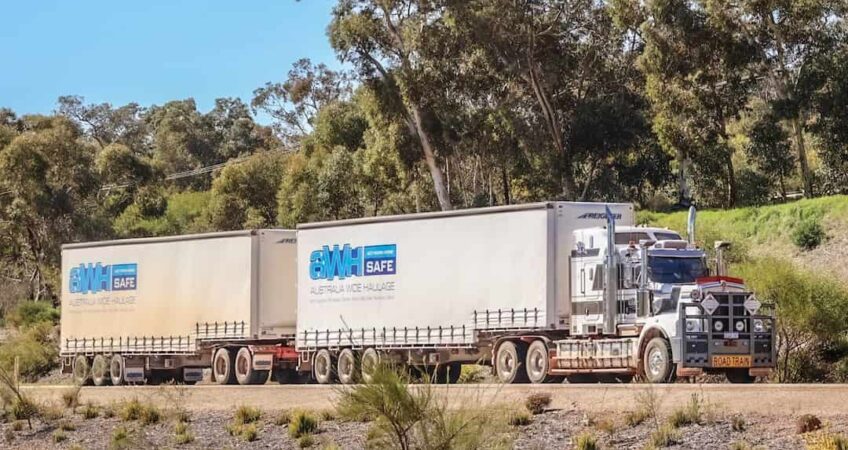
A road train is a prime mover or truck towing two or more trailers. It allows operators to move large freight volumes over long distances.
In Western Australia, road trains carry freight across long regional and remote routes. Main Roads WA requirements determine which configurations can use particular roads and the conditions that apply.
WA freight often travels hundreds or thousands of kilometres. Road trains provide the capacity needed to move larger loads between Perth, regional centres, mine sites, stations and remote projects.
Quick summary
- A road train is a prime mover or truck towing two or more trailers to move larger freight volumes over long distances.
- Common road train configurations in WA include A-doubles, B-triples, AB-triples, BA-triples and A-triples.
- Road train length varies according to the vehicle configuration and Main Roads WA access category. Main Roads advises that road trains operating in WA can range from 27.5 metres to 60 metres.
- Different road train combinations can have different mass, axle group and approved road requirements.
- Main Roads WA administers the vehicle access system used for Restricted Access Vehicles in Western Australia.
- Road trains support mining supply chains, general freight, agriculture, remote deliveries and full truck load freight.
- The right combination depends on freight weight, dimensions, road access, loading requirements and the final delivery site.
What is a road train?
A road train is a heavy vehicle made up of a prime mover or truck and two or more connected trailers.
The prime mover provides the power. The trailers provide the freight capacity.
Different trailer and coupling arrangements can sit behind the prime mover depending on the load, route and required carrying capacity.
This means the term road train does not describe one standard truck.
A road train may be a two-trailer combination or a much longer triple or multi-trailer combination travelling on an approved regional route.
In WA, many larger heavy vehicles operate as Restricted Access Vehicles, usually shortened to RAVs.
Main Roads WA manages access for RAVs across the state's public road network. Its Heavy Vehicle Services section manages permits, orders, access requirements, RAV networks and related operating conditions.
Vehicle length, width, height, total mass and axle loads can determine whether additional access requirements apply. For example, Main Roads identifies a combination exceeding 19 metres as one of the thresholds that can require RAV access arrangements.
Choosing the truck is therefore only part of the transport task. The vehicle must also suit the freight, approved route and delivery site.
How do road train configurations work?
Road train configurations differ mainly by the number of trailers and how those trailers connect.
Two terms appear regularly when discussing road train configurations: A-type and B-type connections.
An A-type arrangement generally uses equipment such as a converter dolly between trailer units.
A B-type arrangement connects the next semi-trailer through a fifth wheel positioned on the trailer in front.
These coupling methods create different road train combinations, including A-doubles, B-triples, AB-triples and A-triples.
| Configuration | General description | Typical WA category examples | Practical use |
|---|---|---|---|
| B-double | Prime mover with two semi-trailers using a B-type connection | Up to 27.5 m in relevant categories | High freight capacity in a shorter combination |
| A-double | Prime mover with two trailers using an A-type arrangement | Up to 27.5 m or 36.5 m depending on category | Common regional road train arrangement |
| B-triple | Three-trailer B-type combination | Up to 36.5 m in relevant categories | Provides additional freight capacity |
| AB-triple | Three trailers using a mix of A and B connections | Often within 36.5 m categories | Used where the approved network allows |
| BA-triple | Another mixed three-trailer arrangement | Often within 36.5 m categories | Access depends on the specific RAV category |
| A-triple | Prime mover towing three trailers using A-type arrangements | Longer categories can extend beyond 36.5 m | High-capacity regional and remote freight |
| Other combinations | Special-purpose multi-trailer combinations | Depends on vehicle category | Used for particular freight and routes |
Main Roads WA publishes specific RAV categories and operating conditions for prime mover and trailer combinations. Maximum dimensions and masses depend on the category rather than the configuration name alone.
Our guide to the types of trailers used in trucking and freight explains other trailers used in road freight and heavy haulage.
How many trailers can a road train have?
A road train has at least two trailers, but the total number depends on the approved configuration and road network.
Common combinations use two or three trailers. Longer specialised combinations can use additional trailer units where the applicable Main Roads WA category and network allow them.
The trailer count alone does not determine whether a vehicle can use a particular route. Overall length, axle groups, mass and configuration also matter.
What does the A or B in a road train configuration mean?
The letter describes the way trailers connect within the combination.
An A connection generally introduces another connection point between the trailers, often using a converter dolly.
A B connection uses a fifth wheel mounted on the trailer in front to connect the next semi-trailer.
The connection type affects the vehicle configuration, turning behaviour and applicable RAV category.
An A-double and B-double can therefore both have two trailers while operating as different combinations.
What is a converter dolly?
A converter dolly is a wheeled coupling unit used to connect a following semi-trailer to the trailer in front.
It gives the following trailer another connection point within an A-type road train configuration.
Converter dollies are an important reason A-type combinations behave differently from B-doubles. Main Roads operating conditions also contain requirements covering dollies, drawbars, trailer gaps and how trailers can move relative to one another.
What is a triple road train?
A triple road train has three trailers, but there are several possible triple configurations.
- B-triples
- AB-triples
- BA-triples
- A-triples
These vehicles do not automatically have the same length, mass limits or road access.
Main Roads WA also maintains specific access arrangements for some short triple road train combinations.
The exact configuration must therefore be identified before the transport team confirms where the road train can operate.
How long is a road train in Western Australia?
Road train length depends on the configuration and Main Roads WA vehicle category.
Main Roads WA advises road users that road trains operating across the state can range from 27.5 metres to 60 metres. Longer road trains of up to 60 metres operate in regional areas, while combinations of up to 42 metres can also be encountered in the Perth metropolitan area.
Standard prime mover RAV categories include a range of shorter and longer combinations, with specific maximum lengths assigned to each vehicle category.
| Approximate length | Examples |
|---|---|
| Around 27.5 m | B-doubles and shorter A-doubles |
| Up to around 36.5 m | Longer A-doubles and several triple configurations |
| Longer regional combinations | Larger triple and other approved road train configurations |
| Up to 60 m | Longer road trains operating on suitable regional networks |
The exact allowable length must be confirmed for the actual vehicle category and network.
Length is only one requirement.
A road train must also comply with applicable axle arrangements, combination masses, vehicle conditions and network access rules.
Some specialised vehicles can operate through Performance Based Standards or other specific access arrangements.
What is the difference between a road train and a B-double?
A B-double is one specific two-trailer combination. A road train is a broader term that can cover several multi-trailer configurations.
The main difference is usually how the trailers connect.
A B-double uses a fifth wheel on the lead trailer to connect the second semi-trailer.
Many traditional road train configurations use an A-type connection with equipment such as a converter dolly.
| Road train | B-double |
|---|---|
| Broad term covering different multi-trailer configurations | A specific two-trailer configuration |
| Can include A-double, B-triple, AB-triple or A-triple combinations | Prime mover plus two semi-trailers |
| A-type combinations can use converter dollies | Second trailer connects using a fifth wheel |
| Longer configurations can extend well beyond a B-double | Shorter than many regional road train configurations |
| Often used for regional and remote freight | Used where its capacity and route access suit the freight task |
Western Australia's vehicle access system for restricted heavy vehicles is administered through Main Roads WA.
For WA road transport, we focus on the exact combination and approved network rather than relying only on labels such as B-double or road train.
Why are road trains used in Western Australia?
Road trains allow large freight volumes to move efficiently across Western Australia's long regional and remote routes.
They can provide a cost-effective road freight option when the freight volume, route and destination make good use of the additional trailer capacity.
A load may leave Perth and travel through the Pilbara or Kimberley before continuing to a mine, station, construction project or remote business.
For suitable freight, a higher-capacity combination can reduce the number of separate vehicle movements needed to move the same volume.

When can a road train make more sense than several smaller trucks?
A road train can make sense when there is enough freight to use the available trailer capacity and the entire route can accommodate the combination.
- Consolidating a large freight volume
- Reducing the number of separate vehicle movements
- Using dedicated capacity for scheduled freight
- Supporting regular regional supply chains
- Moving freight efficiently over long road distances
This does not mean a road train is always cheaper or more suitable.
A shorter truck may make more sense where freight volumes are smaller, access is restricted, deliveries are spread across several tight sites or the load requires specialised equipment.
Mining and resources freight
Road trains support mining supply chains that move large freight volumes between depots, regional centres and remote operations.
Palletised supplies, consumables and maintenance freight
Materials supporting mine and civil projects
Long-distance supply into regional operations
Parts and components for site operations
Freight supporting planned and ongoing maintenance
General freight for remote project requirements
Mine site transport involves more than travelling on the highway.
Our team may also need to account for site inductions, arrival procedures, unloading arrangements, fatigue requirements and access within the mine site.
Our mine and remote transport services are planned around these wider requirements.
Full truck load freight
Road trains can be a practical option for full truck load freight when a customer has enough freight to justify dedicated vehicle capacity.
Suitable loads can include palletised products, packaged materials, industrial supplies and other general freight.
Dedicated capacity can reduce unnecessary freight handling and give the transport plan a clearer loading and delivery schedule.
Our full truck load service can be planned around the volume, route and required delivery timing.
Remote WA freight
Road trains suit many remote WA freight movements because regional distances can be substantial.
Their larger capacity can help move more freight through the long-distance section of the journey.
The final delivery still needs careful planning.
Mine access roads, station tracks and project sites can have tighter corners, limited turning areas or different vehicle access requirements.
Our remote delivery freight service considers the highway journey and final delivery location.
Agriculture and station supplies
Agricultural and pastoral businesses regularly need supplies moved into regional WA.
Freight may include:
- Feed
- Fencing materials
- Consumables
- Machinery parts
- Packaged goods
- Other station supplies
Road trains can provide useful capacity where the freight volume and available road networks support the combination.
Station access, road condition, turning room and unloading facilities still need to be confirmed.
Construction and infrastructure freight
Construction and infrastructure projects can create steady demand for high-volume road freight.
Typical freight may include construction materials, packaged components and project supplies.
Road trains can handle the volume portion of these movements.
Heavy machinery, wide equipment and long indivisible loads may need specialised heavy machinery transport instead.
Where can road trains travel in WA?
Road trains can travel on approved roads that form part of the relevant Restricted Access Vehicle network.
Main Roads WA individually assesses road networks to determine whether they are suitable for particular RAV combinations. Different road train configurations can therefore have different approved networks.
Access for one combination does not automatically apply to another.
For example, a road may accept a shorter combination while restricting a longer triple road train.
This matters when freight leaves a major highway and travels towards:
- A mine site
- Industrial estate
- Station
- Construction project
- Remote community
- Regional depot
- Private access road
- Project access road
The final part of a route can determine whether a particular road train is practical.
For freight moving into the Pilbara, the main highway may allow a combination while the final delivery point needs a different access assessment.
Our freight transport in Karratha service is one example where regional planning can extend beyond the main highway.
Do road trains only operate in remote Western Australia?
No. Longer road trains are strongly associated with regional WA, but road trains also operate within metropolitan areas.
Main Roads WA states that longer combinations of up to 60 metres operate solely in regional areas, while road trains up to 42 metres are commonly encountered in the Perth metropolitan area.
The actual roads available still depend on the RAV combination and approved network.
Does being on a major highway guarantee road train access?
No. A major highway does not automatically allow every road train configuration.
Access depends on the RAV network and vehicle category.
Individual roads may also have conditions involving:
- Bridges
- Intersections
- Turning movements
- Speed limits
- Local restrictions
- Temporary access conditions
Main Roads requires operators and drivers to check current network information and Heavy Vehicle Travel Impacts before operating a RAV.
Flooding, roadworks, bushfires and other disruptions can also affect road trains operating in regional WA.
How do road trains turn and manoeuvre?
Road trains need more space than smaller vehicles to turn because their length and multiple connection points affect the path taken by each trailer.
At intersections and roundabouts, a truck may need to swing wider or use additional road space to complete the turn safely.
Main Roads WA tells motorists not to overtake a truck displaying a Do Not Overtake Turning Vehicle sign while it is completing a turn. Other road users should leave space and wait for the truck to finish the manoeuvre.
The loading yard or delivery site still needs enough room for the selected road train to manoeuvre.
This turning requirement also affects freight planning.
A road may technically form part of an approved network, but the loading yard or delivery site still needs enough room for the selected combination to manoeuvre.
How should a road train movement be planned?
A road train movement should be planned before dispatch around the freight, vehicle, route and delivery site.
The largest available combination is not automatically the right one.
A shorter vehicle may provide enough capacity while giving better access at the final destination.
Confirm the freight requirements
Start with accurate information about the load.
We need to understand:
- Freight type
- Total weight
- Individual item weights
- Dimensions
- Pallet or package count
- Loading method
- Unloading method
- Restraint requirements
- Whether any items are indivisible
Freight volume and weight both affect vehicle selection.
A trailer can reach its legal mass before all available deck or cubic space is filled.
Decide whether a road train suits the load
Road trains generally suit high-volume freight travelling significant distances.
They are not the right vehicle for every large load.
Heavy machinery, wide equipment and long indivisible components may need specialised transport equipment instead.
The transport solution needs to suit the actual freight rather than simply provide the most trailer capacity.
Select the road train configuration
The next step is choosing the right combination.
- B-double
- A-double
- B-triple
- AB-triple
- A-triple
- Another suitable freight vehicle
More trailers do not automatically make the movement more efficient.
Vehicle selection should balance carrying capacity with road and site access.
Confirm RAV route access
The proposed road train should be checked against the current Main Roads WA RAV network.
This assessment needs to cover the full journey.
Checking only the highway can create problems if the vehicle cannot reach the final mine road, industrial estate, station or project site.
Main Roads also requires operators to check Heavy Vehicle Travel Impacts immediately before operating on the public road network.
Check permits and operating requirements
Restricted Access Vehicles must operate under the applicable Main Roads access arrangements.
Requirements may depend on:
- Vehicle configuration
- Overall length
- Width
- Height
- Axle group
- Gross vehicle mass
- Combination masses
- Route
- Operating conditions
Current Main Roads WA requirements should be checked for each movement.
Plan weight distribution and load restraint
Freight needs to sit correctly across the combination.
Poor weight distribution can affect:
- Axle loading
- Stability
- Mass compliance
- Handling
Main Roads operating conditions specify axle-group mass and spacing requirements for relevant combinations.
The transport team also needs to consider restraint points, trailer sequence and unloading order.
Where freight has multiple destinations, the loading plan should reflect the delivery sequence.
Confirm site access and unloading
The destination needs enough room for the road train to enter, position and leave.
Remote and project deliveries may require checks covering:
- Gate access
- Entrance width
- Turning areas
- Site inductions
- Unloading equipment
- Ground condition
- Waiting areas
- Delivery windows
- Site contacts
A road train may travel hundreds of kilometres without issue, then face its biggest access challenge at the final delivery point.
Check road and weather conditions
WA road conditions can change quickly.
Flooding, cyclones, bushfires, roadworks and temporary restrictions can affect regional road transport.
Main Roads states that RAV networks and operating conditions can be amended and requires operators to use current network information.
This matters most for remote and northern WA freight, where alternative roads may be limited.
Australia Wide Haulage plans regional and remote freight around the load, route and final destination.
We are a family-owned WA freight business with origins dating back to 1985 and have operated as Australia Wide Haulage since 2010.
Our team has experience transporting freight to mine sites and remote areas across WA.
We also operate a modern line haul fleet with prime movers rated from 90 to 167 tonnes. Our trained drivers are supported by maintained trucks, trailers and transport equipment.
What rules apply to road trains in Western Australia?
Road trains operating as Restricted Access Vehicles must follow the Main Roads WA requirements that apply to their combination and route.
Depending on the movement, these requirements can cover:
- Permits or operating orders
- Approved RAV network access
- Vehicle dimensions
- Axle group limits
- Combination masses
- WA Heavy Vehicle Accreditation requirements
- Driver licence requirements
- Speed limits
- Following distances
- Other operating conditions
WA Heavy Vehicle Accreditation is mandatory for operators requiring a permit or order to perform transport tasks for hire or reward in WA unless an exemption applies.
A B-double, short triple and longer A-triple should not be treated as having the same access or operating requirements.
Main Roads may also impose road-specific conditions or temporarily restrict access when road or traffic conditions are unsuitable.
Some specialised heavy vehicles may operate through Performance Based Standards or other specific access arrangements.
Current requirements should always be checked against the actual vehicle, freight and route before movement.
Road train access, permits, RAV networks, dimensions and operating conditions can change. Confirm the current Main Roads WA requirements for the specific vehicle combination, freight and route before movement.
Road train FAQs
What licence do you need to drive a road train in Western Australia?
A Multi Combination, or MC, licence is required for heavy combinations towing two or more trailers where each trailer has a GVM greater than 9,000 kg. Transport WA states that applicants must have held a C class licence for at least three years and an HR or HC licence for at least one year before upgrading.
Applicants must also complete and pass the required practical driving assessment through an approved registered training organisation.
How do road trains brake safely with several trailers?
Road trains need substantially more stopping room than smaller vehicles because of their size and mass.
Main Roads WA advises other motorists not to cut closely in front of a RAV because the heavy vehicle driver may not have enough space to stop safely if sudden braking is required. Poor weather can increase the required stopping distance further.
The exact braking and stability systems depend on the vehicle and trailer setup, so individual combinations need to meet the applicable vehicle and operating standards.
How should motorists safely overtake a road train?
Motorists should be patient and wait for a long, clear section of road or an overtaking lane before attempting to pass.
The WA Road Safety Commission recommends staying several car lengths behind while preparing to overtake, ensuring there is a long stretch of straight road ahead and only returning to the left lane when both truck headlights are visible in the rear-view mirror. Drivers towing caravans or trailers should consider waiting for an overtaking lane rather than attempting the manoeuvre in less suitable conditions.
Main Roads also advises motorists never to overtake a turning heavy vehicle displaying a Do Not Overtake Turning Vehicle sign.
What speed can a road train travel in Western Australia?
Road trains are generally limited to a maximum of 100 km/h because they are vehicles towing trailers, while some larger road trains have a 90 km/h limit. Lower limits can also apply on individual roads or to particular RAV categories.
The applicable speed limit for the vehicle and road must always be followed.
Are road train rules the same throughout Australia?
No. Heavy vehicle access and road train rules can differ between jurisdictions.
This article focuses on Western Australia, where Main Roads WA manages RAV networks, permits, orders and access requirements.
Road train dimensions or access conditions published for the Northern Territory, South Australia or another jurisdiction should not be assumed to apply in WA.
Can a road train carry oversized freight?
A road train may transport some larger freight, but an oversized or overmass load can trigger separate access requirements.
Oversize and overmass movements are regulated according to the load, vehicle, dimensions, mass and route. Main Roads WA maintains separate OSOM permit arrangements for relevant heavy vehicle movements.
Where machinery or equipment falls outside standard freight dimensions, our over-dimensional transport service may be a more appropriate transport pathway.
Need to move road train freight in Western Australia?
Road trains provide substantial freight capacity across WA's regional and remote routes, but the right combination depends on more than trailer count.
The freight, vehicle configuration, road network, axle loads, overall mass, site access and unloading requirements all need to work together.
Australia Wide Haulage supports freight movements across mining, construction, agriculture, industrial projects and remote areas throughout WA.
Contact our team to discuss your freight volume, route and timing requirements and determine a suitable transport setup.
Contact our team