
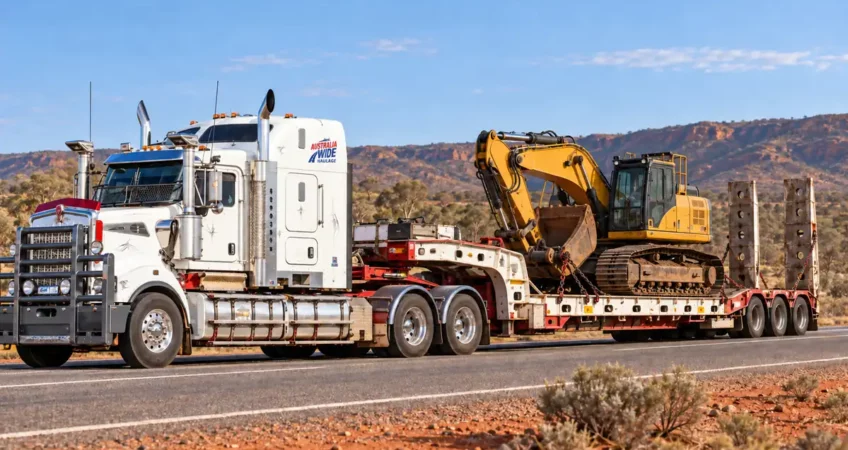
A low loader is a semi-trailer built to carry tall or heavy machinery on a main deck that sits close to the road. The lower carrying position helps manage the total loaded height when moving plant beneath bridges, overhead services and other route constraints.
Low loaders commonly carry excavators, dozers, loaders, graders and industrial plant. The right setup is determined by the machine’s actual dimensions, mass and condition — together with the route, loading method and access at both sites.
Quick summary
- Purpose: carries tall or heavy equipment on a low main deck.
- Common loads: excavators, dozers, loaders, graders, rollers and drilling equipment.
- Capacity: depends on the trailer, prime mover, axle groups, mass distribution and route.
- Remote work: mine-site movements need extra planning for access, site controls, communications and unloading.
- Approvals: a permit or order may apply when the complete vehicle and load exceed general access limits.
- Quote essentials: provide verified dimensions, mass, attachments, machine condition, locations and dates.
What is a low loader?
A low loader forms part of a heavy vehicle combination. Its main carrying deck sits close to the road surface, placing machinery lower than it would sit on many flat deck or standard drop deck trailers.
Different designs use different deck heights, axle groups and loading systems. Some use hydraulic or fixed ramps; others use a detachable front section. These details affect how machinery is loaded, how its mass is distributed and how the journey is planned.
You may also hear this type of trailer called a low bed, lowboy or float. These names are not used consistently. Some businesses also use “low loader” and “drop deck” for overlapping designs, even though the deck arrangements can differ.
The trailer’s design and rated configuration matter more than the name used for it.
For a closer look at another lowered-deck design, read our guide to what a drop deck trailer is.
What can a low loader carry?
A low loader can carry many types of heavy equipment and industrial plant when its configuration suits the load. Common applications include:
The machine category alone does not determine the trailer. Two excavators from a similar operating class may have different track widths, counterweights, attachments and transport masses.
Manufacturer specifications provide a starting point, but the actual machine should be checked. Site modifications, attachments and aftermarket components can change its transport dimensions and mass.
Low loader vs drop deck vs flat deck
A low loader usually suits machinery that benefits from a lower carrying position. Drop deck and flat deck trailers serve different height, loading and freight requirements.
| Trailer type | Basic configuration | Often considered for | Main planning point |
|---|---|---|---|
| Low loader | Low main carrying deck | Tall or heavy mobile plant | Loaded height, loading method and mass distribution |
| Drop deck | Upper deck with a lower main deck | Machinery, equipment and general freight | Available deck height and freight flexibility |
| Flat deck | One open deck above the wheels | Containers, general freight and equipment within height limits | Side and crane access, with a higher deck |
| Extendable | Deck extends to support longer loads | Long structural or industrial items | Support points, turning and rear overhang |
The best option depends on the load, route and collection site. If the correct trailer is unclear, send the machine’s dimensions, mass and loading details to a heavy machinery transport specialist for assessment.
How do we choose a low loader for a job?
We assess the machine, trailer, prime mover, route and sites as one transport task.
Verify dimensions and mass
Confirm the machine’s length, width, height and mass in the exact configuration in which it will travel. Attachments may need to be lowered, removed or transported separately.
Match the equipment combination
Assess deck length, trailer rating, prime mover and axle groups. Some loads may call for a quad-axle or another multi-axle design to distribute mass appropriately.
Check the machine’s condition
A working machine may drive or track onto the trailer. Non-running plant may require a winch, crane or recovery equipment and a different unloading plan.
Review the route
Check road access, structures, overhead clearances, turns, gradients and road surfaces. The complete loaded height and width matter throughout the journey.
Assess both sites
Confirm gates, turning room, ground conditions, loading space, unloading space and any site-specific controls at collection and delivery.
Confirm access requirements
The completed combination, loaded dimensions and proposed route determine whether restricted-access approvals, pilots, escorts or operating conditions may apply.
Australia Wide Haulage operates a modern line-haul fleet with prime movers rated between 90 and 167 tonnes. Those ratings support a range of heavy transport work, but every job still needs its own mass, route and access assessment.
How are loading and unloading handled?
The transport team should load machinery in a controlled area, position it according to the transport plan and restrain it for road travel. The method depends on the machine, trailer and space available.
Prepare the area
Confirm firm, level ground where possible and keep other people and vehicles clear of the loading zone.
Inspect the equipment
Check the machine, trailer, ramps, deck, restraints and rated attachment points before loading.
Load under clear direction
Use an agreed spotter and communication method. Keep people outside travel paths and crush zones.
Position and restrain the machine
Place it according to the planned mass distribution, secure movable parts and use restraints and anchor points suitable for the load.
Complete final checks
Verify dimensions, restraint, loose items and clearances before departure. Recheck the load during the journey where required.
As at September 2026, the National Transport Commission states that Western Australia’s heavy-vehicle loading requirements are contained in the Road Traffic (Vehicles) Regulations 2014, which reference the 2004 Load Restraint Guide. Requirements should be checked again before each movement.
Do low-loader movements need permits in WA?
A low loader does not require a permit simply because of its trailer type. A permit or order may apply when the complete vehicle and load exceed general access limits.
As at September 2026, Main Roads WA generally identifies a vehicle or combination as a Restricted Access Vehicle (RAV) when it exceeds any of the following limits:
Axle and axle-group mass limits also apply. These headline thresholds do not replace an assessment of the vehicle class, network, route and operating conditions.
A movement may need further planning when it is over-width, over-height, over-length or overmass. Our guide to what makes a load over-dimensional in Australia explains these measurements.
The Main Roads WA RAV Mapping Tool provides approved networks, heavy-vehicle travel impacts and restricted-structure information. It must be used with current operating conditions and job-specific approvals. Pilot, escort, route or travel-time conditions may also apply.
Access rules, network conditions and permit requirements can change. Confirm the current requirements for the actual vehicle, load and route before committing to a movement.
How are mine-site and remote moves planned?
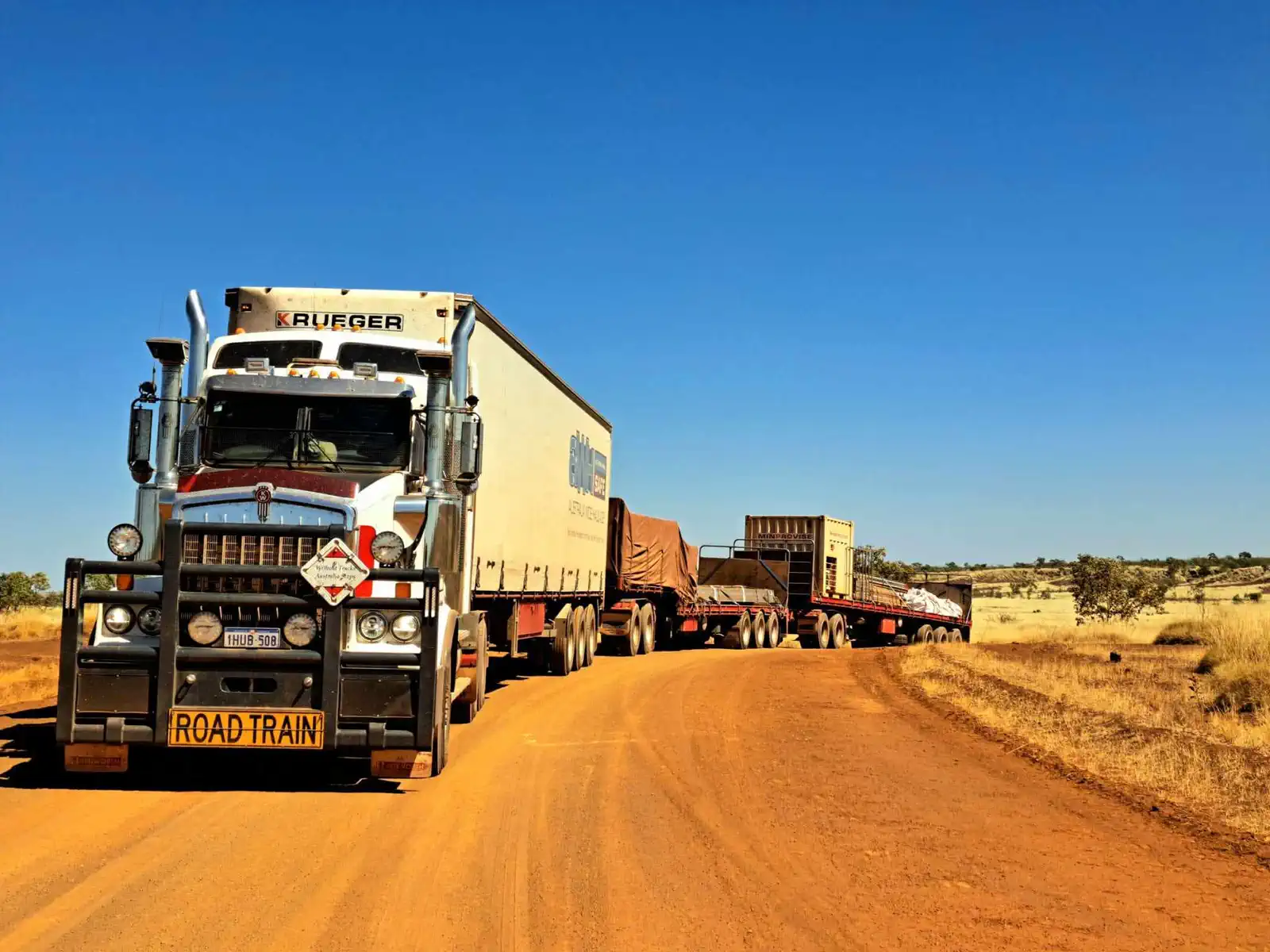
Mine-site and remote low-loader work needs extra planning for site controls, road conditions, communications and support. Long-distance work also requires realistic fuel, fatigue and contingency planning.

- Sealed, unsealed and private-road access
- Seasonal closures and weather conditions
- Mine-site inductions and booking windows
- UHF channels and call-up points
- Journey-management requirements
- Fuel range, rest areas and service support
- Gate widths and wash-down bays
- Unloading conditions and site contacts
The collection and destination contacts should agree on who will load and unload the machine, what support equipment is available and when the site can receive it.
Australia Wide Haulage has experience planning mine and remote transport across Western Australia. Early notice gives the team more time to check the equipment, route, approvals and site requirements.
What affects low-loader transport costs?
Distance matters, but it does not determine the whole price. A reliable quote reflects the work needed to move the machine safely and lawfully.
What information does AWH need for a quote?
Accurate information at the start helps the team assess the trailer, route, loading method and approvals without relying on assumptions.
- Machine make and model
- Verified length, width and height
- Transport mass and centre of gravity, where available
- Attachments and any removable components
- Whether it starts, steers, brakes and self-loads
- Collection and delivery addresses
- Site contacts and access restrictions
- Available loading and unloading facilities
- Required dates or delivery windows
- Current photos or specification sheets
If a dimension or mass is uncertain, say so. The team can identify what must be checked before the movement is booked.
Low-loader FAQs
How many tonnes can a low loader carry?
There is no universal low-loader capacity. It depends on the trailer design, prime mover, axle groups, load position, route access and applicable permit conditions. The actual machine and complete vehicle combination must be assessed.
Can a non-running machine be moved on a low loader?
Yes, when the carrier can develop a suitable loading, restraint and unloading method. The job may need a winch, crane, towing support or recovery equipment, so disclose the machine’s condition when requesting a quote.
How far ahead should I book a low loader?
Book as early as practical when the load may be oversize, overmass, remote or subject to site controls. More lead time allows the carrier to confirm equipment, assess the route, arrange approvals and coordinate site access.
Is a low loader the same as a lowboy or float?
The terms are often used for similar low-deck machinery trailers, but usage varies between operators and manufacturers. Compare the actual deck arrangement, dimensions, rating, axles and loading system instead of relying on the name alone.
Does every excavator need a low loader?
No. Trailer selection depends on the excavator’s actual transport dimensions, mass, attachments, loading method, route and site access. Some machines may suit another trailer configuration.
Main Roads WA — Permits, Orders and Schemes
Main Roads WA — RAV mapping and industry resources
National Transport Commission — Load Restraint Guide
Need a low-loader transport quote?
Australia Wide Haulage is a family-owned Western Australian freight business with origins dating to 1985. Our team transports machinery and equipment for mining, construction, agricultural and industrial projects.
Send the machine details, locations, access requirements and preferred timing. We’ll assess the trailer, loading method, route and transport requirements around the actual job.