
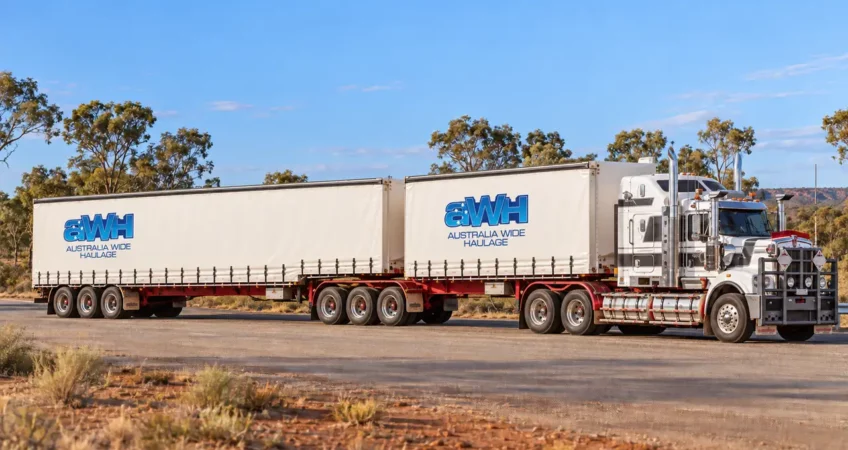
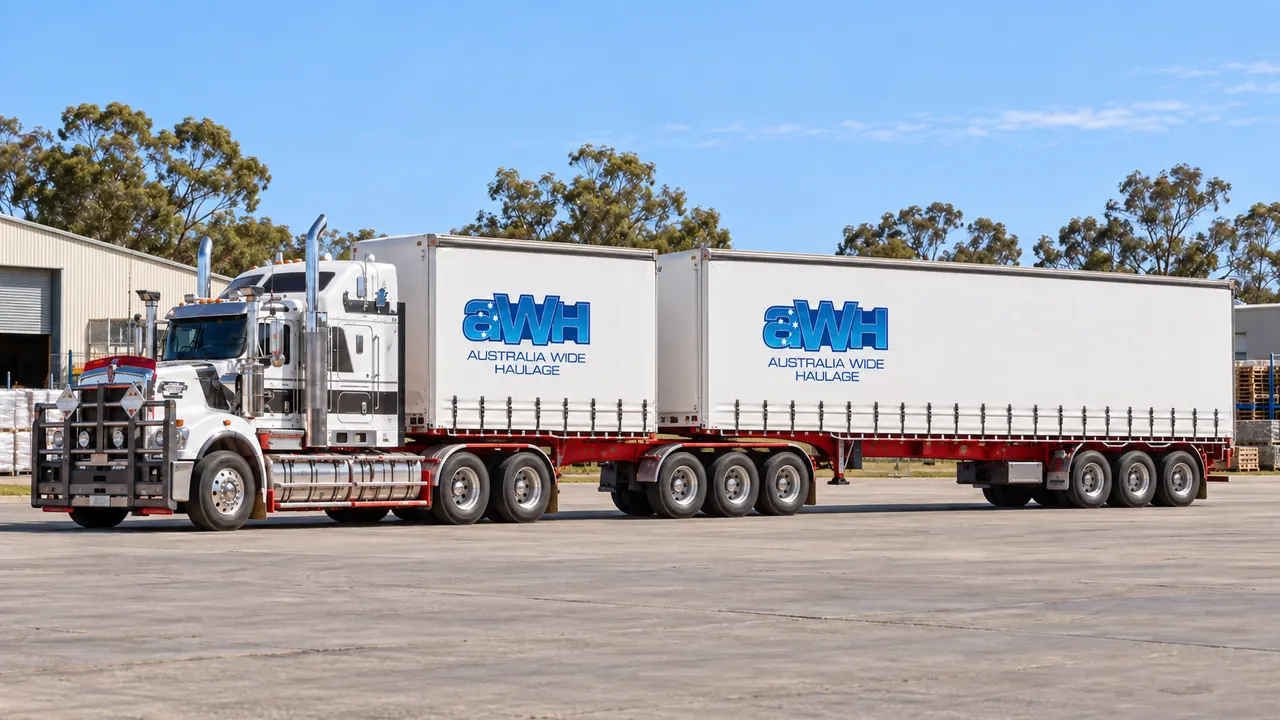
A B-double is a heavy vehicle combination made up of a prime mover and two semi-trailers. The rear trailer connects to a fifth wheel mounted on the lead trailer, creating more loading space than a single semi-trailer in a combination that is shorter than many road trains.
In Western Australia, whether a B-double suits a job depends on the freight, the approved road network and practical access at the collection and delivery sites. Length and mass figures are only the beginning: axle loading, turning space and the complete route also matter.
 B-double freight · Western Australia
Quick summary
- A B-double has one prime mover and two semi-trailers joined by fifth wheel couplings.
- The “B” describes the coupling arrangement; “double” refers to the two trailers.
- In WA, a Category 2C B-double may be up to 27.5 metres long and 72 tonnes total mass, subject to the operating conditions.
- B-doubles and road trains are separate heavy vehicle categories with different connection arrangements and access conditions.
- An accurate quote needs the freight dimensions and weight, exact addresses, dates and site-access details.
Why are they called B-doubles?
The letter “B” identifies the way the trailers connect. A fifth wheel on the prime mover supports the lead trailer, while another fifth wheel at the rear of that lead trailer supports the second semi-trailer.
A fifth wheel is the load-bearing coupling plate. The trailer’s kingpin locks into it, allowing the combination to turn while transferring part of the trailer’s mass through the coupling.

Fifth wheel
The coupling plate mounted on the prime mover or lead trailer. It carries part of the trailer’s mass and allows articulation.
Kingpin
The pin beneath a semi-trailer that locks into the fifth wheel to create the load-bearing connection.
What is the length limit for a B-double in WA?
Under the current Main Roads WA Prime Mover Combinations Operating Conditions, a Category 2C B-double may be up to 27.5 metres overall. A Category 1C short B-double may be up to 20 metres.
The figure is for the complete vehicle combination, not just the trailers. Access also depends on the applicable order or permit, the approved network and any route-specific conditions.
What is the weight limit for a B-double in WA?
A Category 2C B-double has a 72-tonne total mass limit under the current operating conditions. This is the mass of the prime mover, both trailers and the freight combined—it is not the payload available to the customer.
Actual carrying capacity depends on the tare mass of the equipment, axle-group limits, vehicle ratings, freight position and every condition applying to the movement. A combination can remain below the total mass limit and still overload an individual axle group.
Provide the verified weight of the load together with attachments, packing, cradles or transport frames. These items all contribute to total and axle-group mass.
B-double vs road train vs semi-trailer
The clearest difference is the number of trailers and how they connect. A road train may use converter dollies and drawbars, while a B-double uses fifth wheel couplings. Main Roads WA classifies these combinations separately.
| Combination | Trailers | Connection | Maximum length | Total mass limit |
|---|---|---|---|---|
| Single semi (1B) | 1 | No second trailer | 19 m | 50 t |
| B-double (2C) | 2 | Fifth wheel on lead trailer | 27.5 m | 72 t |
| A-double road train (5A) | 2 | Drawbar and converter dolly* | 36.5 m | 89 t |
| B-triple road train (5D) | 3 | Fifth wheel couplings | 36.5 m | 89 t |
| A-triple road train (9A) | 3 | Drawbars and converter dollies* | 53.5 m | 127.5 t |
*For classification purposes, a converter dolly and the semi-trailer it supports count as one trailer. Figures shown are category limits from the current WA operating conditions; axle configuration, ratings, route access and other conditions still apply.

B-double vs semi-trailer
A standard articulated semi-trailer combination has one trailer. A B-double adds a second semi-trailer, increasing usable loading space but also changing the combination’s mass, length, turning path and network-access requirements.
A-double vs B-double
Both have two trailers, but the connection is different. An A-double uses a converter dolly and drawbar between the trailers; a B-double uses a fifth wheel mounted on the lead trailer. See our road train guide for a closer look at common road train configurations.
Where can a B-double travel in WA?
B-doubles do not have unrestricted access to every road. The planned route must be available under the applicable order or permit, and the vehicle must comply with the operating conditions for that access.
For Western Australian work, planners use the Main Roads RAV Mapping Tool and the current access requirements. A mapped route still does not replace checking the final approach, gate, yard and unloading area.
Interstate work requires a separate review because vehicle access and operating conditions can change at the border.
When does a B-double make sense?
A B-double can be efficient when the freight needs more deck or body capacity than a single semi-trailer and both the route and sites can accommodate the larger combination. Common applications include:
The format is not automatically the best option for every larger load. Machinery may require specialised decks, loading equipment or over-dimensional approvals. A full truck load service can be planned around the freight rather than selecting a vehicle by volume alone.
The right comparison is the cost and risk of the whole movement. Splitting freight, transferring it to smaller vehicles or arranging extra handling for constrained sites can offset the benefit of carrying more on the highway leg.
What information is needed for a B-double quote?
Clear details allow the carrier to assess the combination, route and site requirements before pricing the work.
- Freight description and quantity
- Verified weight and dimensions
- Packing, frames or attachments
- Loading and unloading method
- Exact collection and delivery addresses
- Preferred dates and time restrictions
- Site access, gate and turning details
- Contacts and site-entry requirements
Frequently asked questions
What licence is needed to drive a B-double?
In Western Australia, a B-double requires a Multi Combination (MC) driver’s licence. The licence class covers motor vehicles towing two or more trailers when each trailer has a gross vehicle mass greater than 9,000 kg.
Can a B-double carry oversize freight?
It can, but exceeding standard dimension or mass limits changes the movement requirements. The load and combination may need a permit, a prescribed route and other controls under the applicable operating conditions. See our over-dimensional transport service.
Is every two-trailer combination a B-double?
No. The coupling arrangement matters. A B-double uses a fifth wheel on the lead trailer; an A-double road train uses a drawbar and converter dolly between its two trailers.
How much freight can a B-double carry?
There is no single payload figure for every B-double. Payload is the permitted total mass minus the actual tare mass, and it must also comply with axle-group limits, vehicle ratings, freight distribution, route access and operating conditions.
Category figures and access guidance were checked on 5 October 2026 against the current Main Roads WA Prime Mover Combinations Operating Conditions, Heavy Vehicle Orders and Transport WA MC licence guidance. Requirements can change; confirm the current conditions for each movement.
Planning a B-double movement?
Australia Wide Haulage can assess the freight, route and site requirements and recommend a practical transport setup. Send the load details and both addresses for a job-specific quote.